


When your skin stings after washing, turns red for no reason, or reacts to products that work fine for everyone else, you’re not just "sensitive"-you’re likely dealing with a compromised skin barrier. And the biggest culprit? Fragrance. Not just synthetic perfumes, but even "natural" ones like lavender oil or citrus extracts. These aren’t just about smell-they’re triggers. In fact, studies show that fragrance compounds cause 30-45% of all cosmetic-related skin reactions. If you’ve tried dozens of creams and still get flare-ups, it’s time to rethink what’s on your face.
What Does "Fragrance-Free" Really Mean?
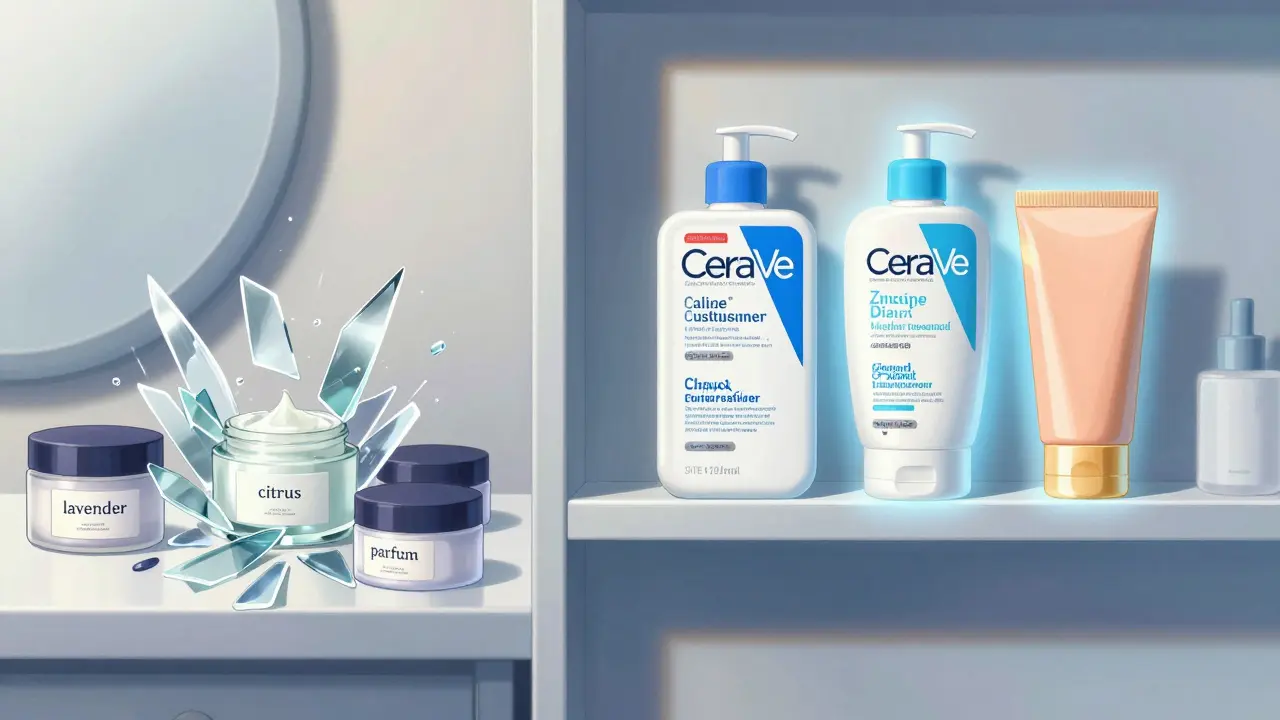
Here’s the trick: "Fragrance-free" and "unscented" aren’t the same. Fragrance-free means no added scent ingredients at all-no perfume, no essential oils, no masking agents. Unscented? That often means they added a fragrance to cover up the smell of other ingredients. It’s still there. And if you’ve got sensitive skin, it doesn’t matter if it’s called "jasmine" or "fragrance-free natural blend." If it’s on the label as "parfum," "aroma," or "essential oil," it can still trigger irritation.
The American Academy of Dermatology and the National Eczema Association both agree: for sensitive skin, you need fragrance-free. That’s why over 1,200 products are now certified by the National Eczema Association. These aren’t just marketing claims-they’ve been tested on people with eczema and rosacea, and verified to contain zero fragrance compounds.
What Actually Works in a Fragrance-Free Routine?
It’s not enough to just remove fragrance. You need to rebuild what’s broken. Your skin’s barrier is like a brick wall. Fragrance and harsh cleansers chip away at the mortar. What you need are ingredients that repair it:
- Ceramides (0.5-3%): These are the natural lipids your skin makes to hold moisture in. When your barrier is damaged, ceramides help patch the gaps. Look for them in cleansers and moisturizers.
- Hyaluronic acid (0.5-2%): This pulls water into your skin. It doesn’t hydrate on its own-it needs water to work. Apply it to damp skin after washing.
- Glycerin (3-10%): A humectant that draws moisture from the air. It’s cheap, effective, and found in most decent fragrance-free products.
- Mineral sunscreen (zinc oxide or titanium dioxide): Chemical sunscreens often contain fragrances or preservatives that irritate. Zinc oxide sits on top of the skin, blocking UV rays without being absorbed. SPF 30+ is non-negotiable.
Products that truly work for sensitive skin usually have 15 ingredients or fewer. More ingredients = more chances for something to go wrong. Brands like CeraVe Hydrating Cleanser and Vanicream Moisturizing Cream are built on this principle. Vanicream, for example, contains only 12 ingredients and no dyes, lanolin, or fragrance. Clinical testing showed it improved hydration by 42% over scented moisturizers and caused 78% fewer reactions.
How to Test a New Product (Without Ruining Your Skin)
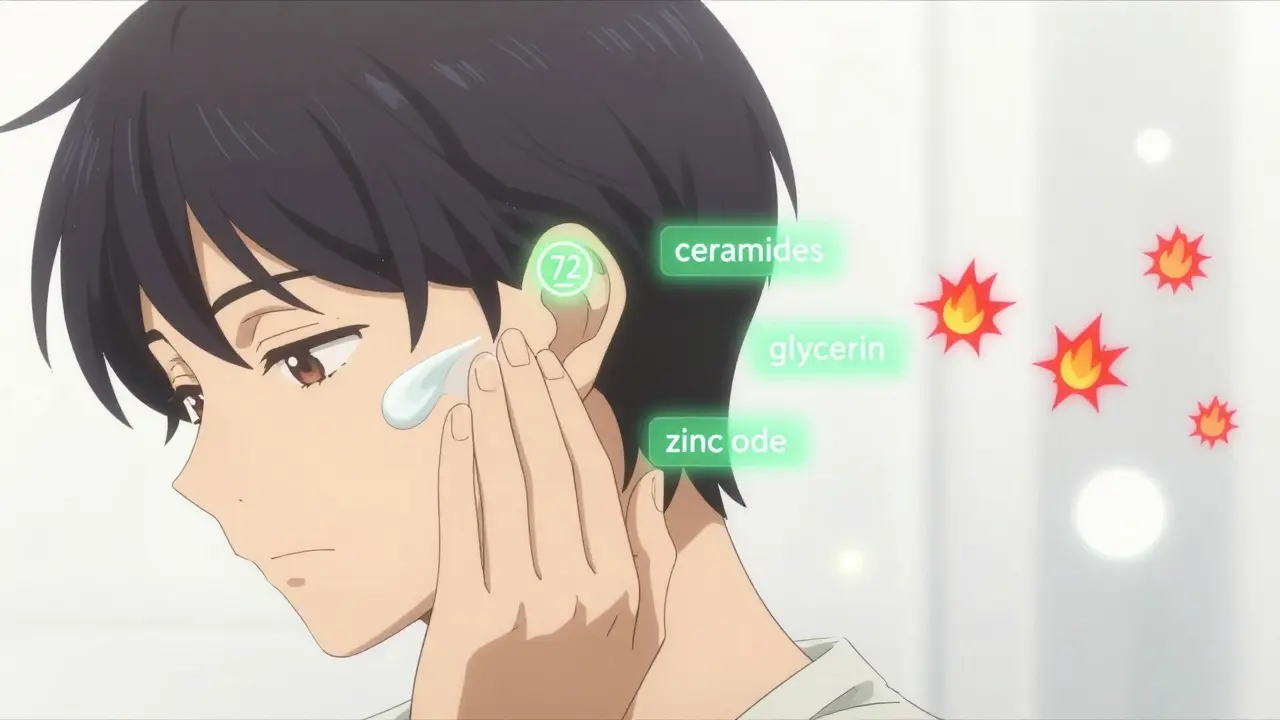
Don’t slap a new cream on your whole face and hope for the best. That’s how you end up with a 3-day flare-up. The gold standard? A 72-hour patch test.
- Wash and dry the skin behind your ear.
- Apply a pea-sized amount of the product.
- Leave it on for 72 hours. Don’t wash it off.
- Check for redness, itching, burning, or flaking.
Why 72 hours? Because 37% of reactions are delayed. A 24-hour test misses these. If you see no reaction after 3 days, it’s likely safe. Then, test it on your jawline for 3 more days before going full-face.
Pro tip: Use the same patch test method for sunscreen, even if it’s labeled "for sensitive skin." Not all mineral sunscreens are created equal. Some still contain emulsifiers or preservatives that irritate.
What to Look for on the Ingredient List
INCI (International Nomenclature of Cosmetic Ingredients) labels are your friend. Learn to scan them fast:
- Avoid: fragrance, parfum, aroma, essential oil, lavender oil, citrus oil, geranium oil, peppermint oil, ylang-ylang.
- Look for: ceramide NP, ceramide AP, ceramide EOP, hyaluronic acid, glycerin, squalane, niacinamide (in low doses), zinc oxide.
Here’s the scary part: a 2023 analysis by Pretty Farm Girl found that 68% of products labeled "natural" still contain fragrance. Even brands marketed for sensitive skin-like some labeled "hypoallergenic"-have hidden scents. Cleure’s own testing showed that 58% of products claiming to be for sensitive skin still had fragrance compounds. Always read the full list. Don’t trust buzzwords.
Why Fragrance-Free Isn’t Just for Eczema
You don’t need a diagnosis to benefit. Over half of people who switch to fragrance-free routines aren’t diagnosed with eczema or rosacea-they just know their skin reacts. Reddit’s r/SkincareAddiction community (1.2 million members) found that 78% of users saw major improvement within 4-6 weeks. The top reports? Less redness (83%), less stinging (79%), and less reactivity to weather, pollution, or stress (76%).
Even people with acne-prone skin benefit. Non-comedogenic, fragrance-free cleansers like SVR’s SENSIFINE Cleansing Balm remove makeup and oil without stripping the skin. Lab tests showed it kept skin hydration at 82% after 24 hours-far higher than conventional cleansers (65-70%). That’s because it’s made with just 9 ingredients and has a pH of 5.2, which matches your skin’s natural acid mantle.
The Downsides (And How to Deal With Them)
Let’s be honest: fragrance-free products don’t smell good. They don’t smell like anything. That’s the point. But 63% of users in a Skincare.com survey said they found the lack of scent "clinical" or "uninspiring." It can make sticking to a routine harder.
Here’s what works:
- Use the "wrist perfume method"-apply your favorite scented perfume to your wrist, then gently rub your hands together and pat your neck or chest. You get the scent without touching your face.
- Focus on texture. Some fragrance-free moisturizers have a rich, balm-like feel that feels luxurious even without scent.
- Think long-term. The goal isn’t to enjoy the moment-it’s to stop the irritation. After 3 weeks, most users say they don’t miss the smell.
Cost is another concern. Fragrance-free products average $28.50, compared to $22.75 for regular ones. But consider this: if you’re spending $50/month on creams that make your skin worse, you’re wasting money. A simple, effective routine with 2-3 products costs less than $60/month and lasts longer because you use less.
What the Experts Say
Dr. Whitney Bowe, a board-certified dermatologist, calls fragrance "the single most common cause of allergic contact dermatitis in skincare." Dr. Sandy Skotnicki’s research showed that removing fragrance cut inflammatory markers like IL-6 by 57% in sensitive skin patients. And Dr. David Leffell at Yale warns: "Natural doesn’t mean safe." Essential oils trigger reactions in 22% of sensitive skin patients.
The American Academy of Dermatology’s 2023 guidelines are clear: start with three products-fragrance-free cleanser, moisturizer, and mineral sunscreen. Wait 4 weeks. Then, if your skin is calm, add one more product at a time.
Market Shifts and What’s Coming
The fragrance-free skincare market hit $3.8 billion in 2023 and is growing at 17% a year-nearly triple the rate of the overall skincare industry. Why? Because people are learning the truth: fragrance isn’t a luxury. It’s a risk.
California’s proposed Fragrance Ingredient Transparency Act (AB 1234) would force brands to list every single fragrance component-no more hiding behind "fragrance." The EU already requires disclosure of 26 known allergens. The U.S. FDA is moving in the same direction.
Meanwhile, brands like Cleure and SVR are launching clinical trial kits used by over 1,200 dermatology practices. And sales of fragrance-free cleansers like CeraVe’s Hydrating Cleanser have hit $1.2 billion annually.
This isn’t a trend. It’s a shift. More than 73% of consumers now actively seek "clean" fragrance alternatives-even if they don’t have sensitive skin.
Start Simple. Stick With It.
You don’t need 10 products. You don’t need to spend $200. You need:
- A fragrance-free cleanser (use once daily-morning or night, not both).
- A ceramide-based moisturizer (apply to damp skin within 30 seconds of washing).
- A mineral sunscreen with zinc oxide (SPF 30+, reapplied if outside for long periods).
Wait 4 weeks. No new products. No changes. Then, if your skin is calmer, you can add one more item. Most people see improvement in 2-3 weeks. Full results? By week 6.
If your skin still reacts? Go back to basics. Strip everything except water and sunscreen. Give your barrier time to heal. Then, reintroduce one product at a time.
Fragrance-free isn’t about deprivation. It’s about removing what’s harming you so your skin can finally recover. And once it does? You won’t miss the smell. You’ll just feel better.
Can I still use essential oils if I have sensitive skin?
No. Even "natural" essential oils like lavender, tea tree, or citrus are common triggers for sensitive skin. Studies show they cause reactions in up to 22% of people with reactive skin. The skin doesn’t care if something is natural-it only reacts to the chemical structure. Fragrance-free means zero added scents, period.
How do I know if a product is truly fragrance-free?
Check the ingredient list for "fragrance," "parfum," "aroma," or any essential oil. Even if it says "unscented," it may still contain masking agents. Look for certification from the National Eczema Association or brands like CeraVe, Vanicream, or Cleure that publicly verify their ingredients through third-party testing.
Is fragrance-free skincare only for people with eczema?
No. While it’s essential for eczema and rosacea, over 59% of people who use fragrance-free products don’t have a formal diagnosis. They just know their skin reacts to scented products. If your skin stings, itches, or turns red after using a cream, you’re likely a candidate for a fragrance-free routine.
Why do fragrance-free products cost more?
They often use purer, simpler ingredients and undergo rigorous testing to ensure zero fragrance. They’re also produced in smaller batches for medical-grade standards. But consider this: if scented products cause reactions, you’re wasting money on products that harm your skin. A simple 3-step routine can last months and prevent costly dermatologist visits.
Can I use fragrance-free products if I have oily skin?
Yes. Many fragrance-free moisturizers are lightweight and non-comedogenic. Look for gel-based formulas with hyaluronic acid and glycerin-they hydrate without clogging pores. Brands like CeraVe and SVR offer options specifically designed for oily, sensitive skin.







Comments (12)
RacRac Rachel
March 3, 2026 AT 04:04 AMOMG I SOOOO needed this 😭 I switched to CeraVe last month and my face stopped looking like a tomato after washing! No more stinging, no more red patches... I even started using the Vanicream moisturizer and now my skin feels like silk. Fragrance-free isn't boring-it's revolutionary. 🙌
Jane Ryan Ryder
March 4, 2026 AT 09:52 AMWow. So let me get this straight. You’re telling me I have to give up my $80 French lavender face cream because my skin might feel something? I’m not sensitive. I’m just classy.
Callum Duffy
March 4, 2026 AT 11:25 AMThank you for this meticulously researched and clinically grounded exposition. The distinction between 'fragrance-free' and 'unscented' is indeed frequently misunderstood, even among dermatological professionals. The data cited regarding delayed reactions-37% occurring beyond 24 hours-is particularly compelling. A rigorous, evidence-based approach to skin barrier repair remains indispensable.
Levi Viloria
March 5, 2026 AT 04:59 AMI’ve been using a fragrance-free routine for two years now. Started because my cheeks burned every time I used a new serum. Now? I don’t even notice what I’m applying. It’s weirdly peaceful. Like my skin finally got some peace and quiet. Also-mineral sunscreen is a game-changer. Zinc oxide doesn’t lie.
Richard Elric5111
March 5, 2026 AT 18:10 PMThe philosophical underpinning of this discourse reveals a deeper epistemological tension: the human desire for sensory indulgence versus the biological imperative of homeostatic equilibrium. Fragrance, as a cultural artifact of olfactory seduction, functions as an anthropogenic irritant-an artifact of symbolic consumption masking physiological vulnerability. To forsake scent is not deprivation, but transcendence.
Dean Jones
March 6, 2026 AT 18:36 PMLook, I get it. Fragrance is bad. But let’s be real here-most of these 'fragrance-free' products smell like wet cardboard and regret. I’ve tried five different brands. One had a weird chemical tang. Another felt like I was slathering on glue. And don’t even get me started on the texture. Why do they all have to be so… thick? Like, I’m not asking for a rose garden. I just want something that doesn’t make my skin scream. I switched to just using plain glycerin and water. It works. It’s cheap. And I don’t have to read a 12-ingredient label like it’s a PhD thesis. Sometimes the simplest fix is the one no one talks about.
Zacharia Reda
March 8, 2026 AT 11:48 AMWait-so you’re telling me my 'natural' toner with rosewater and chamomile was the whole problem? 😅 I feel like an idiot. But honestly? My skin hasn’t broken out in 3 weeks since I switched. I’m now obsessed with checking ingredient lists. I even tested a new serum behind my ear for 72 hours. It’s wild how much better I feel. Thanks for the nudge. I didn’t even know I was being so reckless.
Jeff Card
March 8, 2026 AT 13:43 PMI’ve had sensitive skin since I was 12. This post made me cry. Not because it’s sad-because someone finally said it like it is. No judgment. No fluff. Just facts. I’ve been using Vanicream for 8 months now. My skin doesn’t burn when I go outside. I can wear a hat without itching. I didn’t think it was possible. Thank you.
Sharon Lammas
March 9, 2026 AT 13:17 PMThere’s something deeply spiritual about removing what harms you-not just for your skin, but for your peace. I used to think fragrance was self-care. Now I realize it was self-deception. The quietness of fragrance-free products? It’s not empty. It’s healing.
marjorie arsenault
March 9, 2026 AT 19:13 PMYou got this! Start with just the cleanser and moisturizer. Don’t overthink it. Your skin will thank you. And if you feel like giving up? Come back here. We’ve all been there. You’re not alone.
Deborah Dennis
March 10, 2026 AT 11:49 AMWow. So much information. So many numbers. So many brands. So many 'studies.' But where’s the proof? Did anyone actually track how many people got worse after switching? Or is this just another 'clean beauty' cult?
Donna Zurick
March 11, 2026 AT 16:21 PMI tried the patch test behind my ear. Didn’t react. Then tried it on my jawline. Still fine. Then I used it on my whole face. Still fine. And now I’m obsessed. I didn’t think I’d ever love a product that smells like nothing. But I do. Because my skin is finally calm. And that’s worth more than any lavender scent ever was.