
When you start a new medication, it’s normal to wonder: is this feeling something the drug is causing-or is it just my body being weird? A symptom diary isn’t just for doctors. It’s your best tool to find out what’s really going on. If you’ve noticed dizziness after taking your blood pressure pill, a rash after starting a new antibiotic, or nausea that shows up every time you take your painkiller, writing it down can make all the difference. This isn’t about guessing. It’s about tracking. And when you have clear, timed records, your doctor can see the pattern-before it turns into a bigger problem.
What Goes in a Symptom Diary?
A good symptom diary doesn’t just say "I felt sick." It answers the who, what, when, where, and why. The National Institute on Aging’s guidelines say you need nine key pieces of information. Here’s what to record every time you take a drug or notice a change:
- Date and time you took the medication (to the minute). Don’t guess. Use your phone’s clock.
- Exact dose and how you took it-was it 5 mg tablet? 10 mL liquid? Swallowed or applied to skin?
- Every other medication or supplement you took that day-even aspirin, vitamin D, or herbal tea. These can interact.
- What you felt: "Headache" isn’t enough. Say "throbbing pain on the left side, behind the eye, started 45 minutes after taking the pill." Location matters.
- When the symptom started after taking the drug. Did it hit 20 minutes later? 3 hours? This tells your doctor if it’s likely linked.
- How long it lasted. Did it fade in an hour? Last all day? Come and go?
- What else was going on-were you stressed? Hot? Just got off a flight? Exercise? These can mimic or worsen reactions.
- What you did to fix it. Did you lie down? Take antihistamines? Drink water? Note it.
- Did it go away? Fully? Partially? Never? This tells if the reaction resolved on its own or needed help.
For severity, use the Common Terminology Criteria for Adverse Events (CTCAE). It’s simple:
- Grade 1: Mild, barely noticeable. You can still do normal stuff.
- Grade 2: Noticeable, bothersome. Might affect daily tasks.
- Grade 3: Severe. You can’t do normal activities. May need medical help.
- Grade 4: Life-threatening. Emergency situation.
- Grade 5: Death.
You don’t need to be a doctor to use this. If you’re too dizzy to walk, that’s Grade 3. If you’re just a little tired, that’s Grade 1. Be honest. Don’t downplay.
Why Paper Doesn’t Work (Most of the Time)
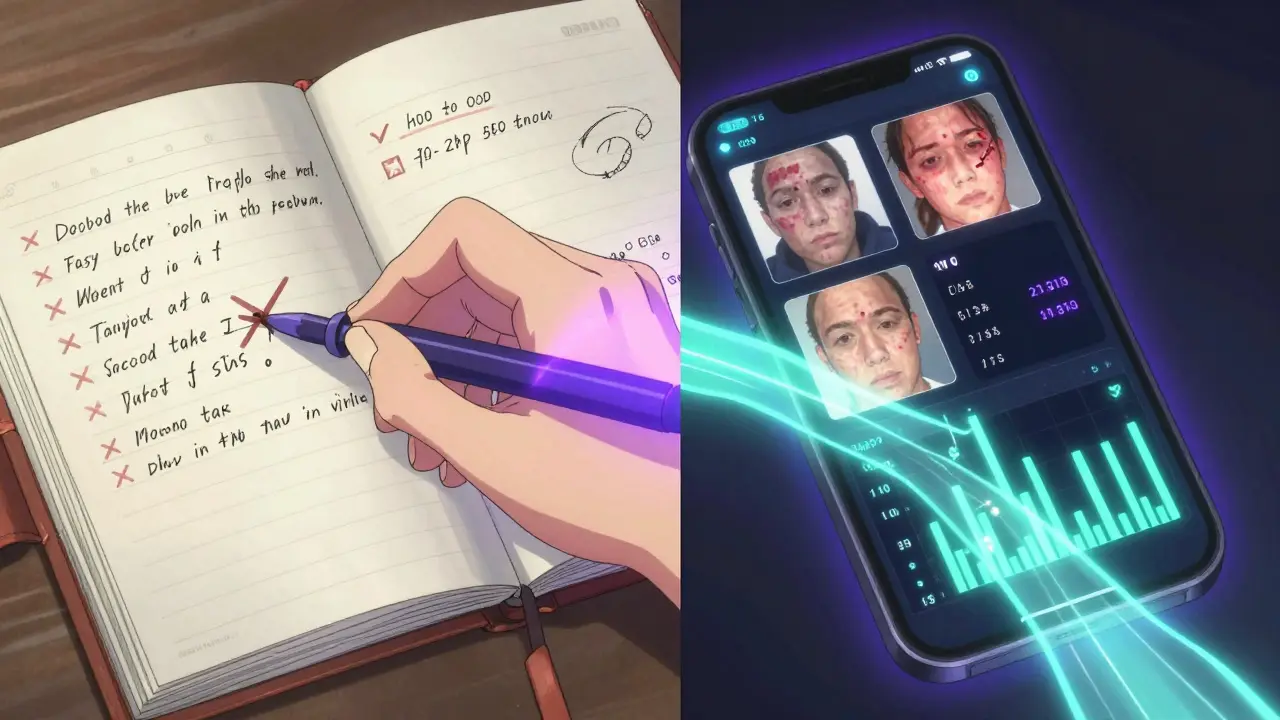
Many people start with a notebook. They write "took pill, felt weird." Then they forget. Or they skip days. Or they lose the book. A 2023 study from Scripps Research found that 57% of people who used paper diaries gave up within three days. Why? It’s too slow. Too messy. Too easy to forget.
Apps like Medisafe, CareClinic, and MyTherapy fix this. They:
- Auto-time-stamp entries when you open them.
- Send you reminders to log symptoms or take meds.
- Generate charts that show if symptoms spike right after a certain drug.
- Let you take photos of rashes or swelling-something text can’t capture.
And here’s the kicker: the European Medicines Agency found that adding a photo of a skin reaction boosted diagnostic accuracy by 78%. A blurry selfie of a rash is worth more than a paragraph describing it.
When to Start-and When to Stop
Start the diary the day you start the new drug. Don’t wait for symptoms. Record how you feel even if you feel fine. That baseline matters. If you don’t know what normal looks like, you can’t spot the change.
Keep going for at least two weeks. Some reactions take time to show up. Others come and go. A 2024 study from La Roche-Posay showed patients who kept detailed diaries for two weeks reduced their need for extra tests by 37%. Why? Because doctors could see the pattern without guessing.
Stop only when your doctor confirms the reaction is understood-or the drug is stopped. Don’t quit just because it feels better. The reaction might return.
What Not to Document (Yes, There’s a Right Way and a Wrong Way)
Not every tiny change counts. A 2022 study by the Institute for Safe Medication Practices found that 41% of diaries were cluttered with irrelevant info. People wrote down "I felt a little tired" after every pill-even when tiredness is a known side effect. That’s noise. And noise hides the real signal.
Focus on:
- Unexpected symptoms
- Symptoms that get worse over time
- Symptoms that happen only with one specific drug
- Symptoms that interfere with daily life
Ignore:
- Expected side effects (like mild nausea from antibiotics) unless they get severe
- General feelings like "I’m just off today"
- Things that happen when you’re sick with the flu
Be selective. Your goal isn’t to fill pages. It’s to give your doctor one clear story: "This drug caused this reaction. Here’s when, how, and why."
How to Make It Stick
Consistency beats perfection. You don’t need to be flawless. But you do need to be regular. Here’s how to make it work:
- Set a daily alarm: "Log symptoms" at 8 PM. Even if you didn’t feel anything, tap "no change."
- Use your phone: Sync your medication log with Apple Health or Google Fit. They’ll remind you.
- Keep it visible: Put your phone on the counter next to your pill box.
- Review every Sunday: Look back. Did anything happen every time you took Drug X? Highlight it.
- Bring it to every appointment: Even if it’s just a 10-minute check-in. Show the chart.
People who do this report better communication with doctors. On Reddit’s r/Pharmacy, users say things like: "My neurologist dismissed my dizziness until I showed the 14-day diary correlating levodopa doses with symptom spikes. They adjusted my regimen within 48 hours."

What Happens After You Document It?
Once you have a clear pattern, take it to your doctor. Don’t say, "I think this drug is making me sick." Say: "Every time I take this pill at 8 AM, I get a headache by 10 AM that lasts until 2 PM. I took it 11 times in two weeks. Each time, same pattern. I’ve attached a screenshot of the app chart."
Doctors can’t fix what they can’t see. And they don’t have time to guess. Your diary gives them proof. In 2023, the FDA said symptom diaries with precise timing reduce false positive reports by 62%. That means fewer unnecessary drug changes-and fewer missed dangers.
For serious reactions-like trouble breathing, swelling of the throat, chest pain, or sudden confusion-call 999 immediately. Then add it to your diary. The NIH says serious events must be logged within 72 hours. Memory fades fast. Don’t rely on it.
Common Mistakes (And How to Avoid Them)
- Not logging concurrent meds: 71% of errors come from forgetting supplements or OTC drugs. Write down everything.
- Skipping environmental factors: 89% of incomplete diaries leave this out. Was it hot? Were you stressed? That matters.
- Using vague terms: "I felt bad" is useless. "I had sharp pain in my right shoulder that made it hard to lift my arm" is useful.
- Waiting to write it: If you wait more than 15 minutes, your memory gets fuzzy. Write it right away.
Fix these by using pre-made templates in apps. They have checkboxes for common symptoms and drop-downs for medications. No guessing. Just tapping.
What’s Next for Symptom Diaries?
The future is already here. The FDA is testing systems that connect your diary directly to your electronic health record. If your app shows a pattern matching a known drug reaction, your doctor gets an alert. Google’s Verily platform can predict drug reactions from diary data with 89% accuracy. It’s not science fiction-it’s being tested in hospitals right now.
And it’s not just for the sick. It’s for anyone taking meds. One in five people experience a drug reaction. Most never report it. That’s why diaries are becoming standard-not optional.
Start today. Not tomorrow. Not next week. Today. Your body is talking. This is how you listen.
Do I need to log every single pill I take?
No. Focus on the new drug you suspect is causing the reaction. But always log any other medication, supplement, or OTC drug you take that day-even aspirin or melatonin. These can interact. You don’t need to log every vitamin you’ve taken for years, just what’s new or changed around the time symptoms started.
What if I forget to log a symptom?
If you forget, write it in as soon as you remember-but mark it as "late entry." Apps let you add notes like "Logged 2 hours late." It’s better than nothing. But don’t rely on this. The goal is to log within 15 minutes of symptom onset. That’s when your memory is still sharp and the timing is accurate.
Can I use a paper diary instead of an app?
Yes, but it’s harder to keep consistent. Paper diaries have a 57% abandonment rate within 72 hours. Apps have reminders, auto-timestamps, and charts. If you use paper, print a pre-made template with checkboxes for symptoms and times. Keep it next to your pill box. But if you’re serious about finding the cause, an app is far more reliable.
How long should I keep the diary before seeing my doctor?
At least two weeks. Some reactions take time to appear. If symptoms are severe (Grade 3 or higher), don’t wait-see your doctor immediately. But for unclear patterns, two weeks gives you enough data to spot trends. A 2024 study showed patients who tracked for two weeks reduced diagnostic testing by 37%.
What if my doctor doesn’t believe me?
Show them the chart. Say: "I’ve tracked this for 14 days. Every time I take this drug, I get [symptom] within [time]. Here’s the screenshot. I’ve included the exact time, dose, and other meds. I’ve also noted my activity and environment. I’m not guessing-I’m reporting." The FDA says diaries with timing reduce false reports by 62%. That’s data, not opinion.