


When your liver is damaged by cirrhosis, your body doesn’t just struggle to filter toxins-it starts breaking down your own muscle just to stay alive. This isn’t a slow decline. It’s a silent, accelerating loss of strength that increases your risk of death by two to three times. The good news? What you eat right now can stop it. And the most important thing? You need more protein, not less.
Why Protein Restriction Is Outdated (and Dangerous)
For decades, doctors told people with cirrhosis to cut back on protein. The logic was simple: less protein = less ammonia = fewer brain fog episodes. It made sense. But it was wrong. A landmark 2004 study changed everything. Researchers gave 30 patients with cirrhosis either a very low-protein diet (0.5 grams per kilogram of body weight) or a normal-protein diet (1.2 grams per kilogram). The low-protein group didn’t get better. Instead, their bodies started eating their own muscle to survive. Their muscle loss was worse. Their ammonia levels? No different. Today, the American Association for the Study of Liver Diseases (AASLD) says protein restriction is not just unnecessary-it’s harmful. If you’re still being told to limit protein because of hepatic encephalopathy, ask your doctor to review the latest guidelines. You’re not protecting your brain. You’re starving your muscles.How Much Protein Do You Actually Need?
Forget the old 40-60 grams a day rule. That’s for someone who’s sedentary and healthy. With cirrhosis, you’re burning energy just to breathe, move, and keep your organs working. The current standard is 1.2 to 1.5 grams of protein per kilogram of ideal body weight each day. If you weigh 70 kg (about 154 lbs), that’s 84 to 105 grams of protein daily. If you’re already losing muscle (sarcopenia), aim for the higher end: 1.5 g/kg. For those who are very ill or hospitalized, the range goes up to 1.2-2.0 g/kg. That’s not a mistake. Your body is in crisis mode. You need fuel. But here’s the catch: use dry weight or ideal body weight. Cirrhosis causes fluid buildup in the belly and legs (ascites and edema). If you weigh yourself on a scale with all that extra water, you’ll think you’re heavier than you are-and end up underfeeding. A 200 lb person with fluid retention might only have a dry weight of 160 lbs. That’s the number that matters.Not All Protein Is Created Equal
You can hit your protein goal with steak, chicken, and eggs-but that’s not the best path. The liver in cirrhosis struggles to process animal protein, and it can trigger more ammonia spikes. Instead, focus on these sources:- Low-sodium cheese and cottage cheese
- Eggs
- Yogurt and kefir
- Milk (8 oz = 8g protein)
- Tofu and tempeh
- Lentils, beans, and chickpeas
- Edamame
- Nuts and seeds
- Oatmeal
- Wild rice
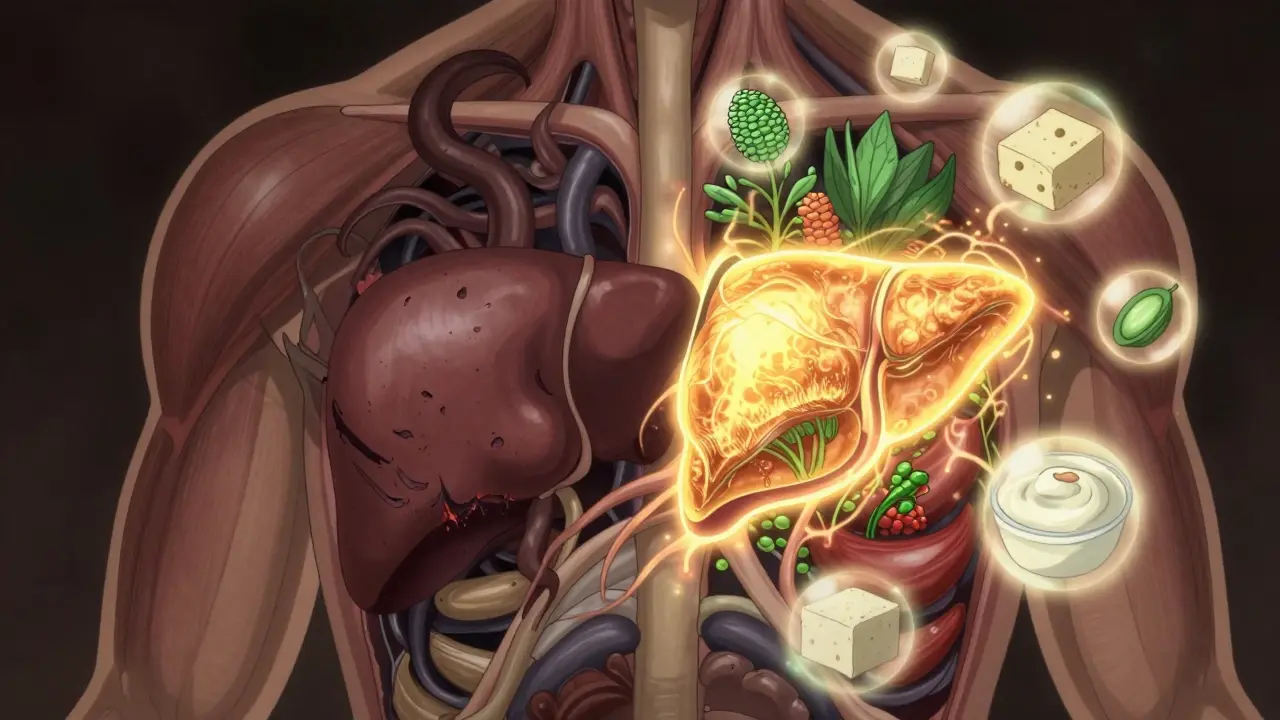
Meal Timing Matters More Than You Think
It’s not just how much you eat. It’s when. Your body doesn’t store protein like it stores fat or carbs. If you go more than 4 hours without eating, your muscles start breaking down. Overnight? That’s 8-10 hours of fasting. That’s a disaster. Experts recommend:- 3-5 meals a day, spaced no more than 3-4 hours apart
- A high-protein snack 1-2 hours before bed
- 1 cup Greek yogurt with a tablespoon of almond butter
- 2 hard-boiled eggs and a slice of whole grain toast
- Half a cup of cottage cheese with sliced peaches
- A protein shake made with milk and a scoop of whey or soy protein
Calories Are Just as Important as Protein
If you’re not eating enough total calories, your body will use protein for energy instead of muscle repair. That defeats the whole purpose. AASLD recommends:- 35 kcal per kg of dry weight if your BMI is normal
- 25-35 kcal per kg if your BMI is 30-40
- 20-25 kcal per kg if your BMI is over 40
- Choose whole milk over skim
- Add olive oil or avocado to meals
- Use nut butters instead of jam
- Include dried fruit, cheese, and full-fat yogurt
What About Sodium and Fluids?
Many people with cirrhosis are told to cut salt to control fluid buildup. But if you’re struggling to eat, being too strict on sodium can backfire. If you can’t keep down enough food because you’re too full from fluid, or you’re losing weight because you can’t stomach low-salt meals, then your doctor might need to loosen restrictions. The goal isn’t perfection. It’s survival. A little extra salt on your beans or eggs might mean the difference between eating 80g of protein and only 40g. Work with your care team to find the right balance.
Micronutrients You Might Be Missing
Cirrhosis messes with how your body absorbs and uses vitamins and minerals. Common deficiencies include:- Zinc (helps with taste, wound healing, and ammonia processing)
- Thiamine (B1) and B6
- Folate
- Magnesium
What If You Can’t Eat Enough?
Loss of appetite, early fullness, nausea, and taste changes are common. You’re not failing. Your disease is fighting you. Solutions:- Try smaller, more frequent meals (6 per day if needed)
- Use high-protein snacks: Nature Valley Protein bars (40g protein), Clif Builder’s Bars (68g), or protein powders
- Make smoothies with milk, yogurt, peanut butter, and banana
- Use flavor enhancers like herbs, lemon juice, or low-sodium sauces to improve taste
- Ask your doctor about appetite stimulants or a referral to a dietitian
The Bottom Line: Protein Saves Lives
Sarcopenia (muscle loss) in cirrhosis isn’t just about weakness. It’s a direct predictor of death. A 2019 study found that nearly half of patients on the liver transplant waiting list had sarcopenia-and they were 2.8 times more likely to die before getting a transplant. You can change that. Eat enough protein. Eat it often. Choose plant and dairy sources. Don’t skip the bedtime snack. Get calories in, even if you have to use oils or supplements. This isn’t about dieting. It’s about survival. Your body is burning through muscle just to keep you alive. You have the power to stop it. Start today.Should I avoid protein if I have hepatic encephalopathy?
No. Avoiding protein won’t improve brain fog and will make muscle loss worse. Modern guidelines from AASLD and other liver societies say protein restriction is outdated. Focus on plant- and dairy-based proteins, eat frequently, and avoid long fasting periods. If you have severe encephalopathy, work with a dietitian to adjust your intake-but don’t cut protein.
How do I calculate my protein needs with fluid retention?
Use your dry weight or ideal body weight, not your actual scale weight. Dry weight is your weight after diuretics have removed excess fluid. If you don’t know your dry weight, ask your doctor or dietitian. As a rough estimate: Ideal body weight for men = 50 kg + 2.3 kg for each inch over 5 feet. For women = 45.5 kg + 2.3 kg for each inch over 5 feet. Then multiply by 1.2-1.5 g/kg.
Can I use protein powders if I have cirrhosis?
Yes, but choose wisely. Whey protein is often well tolerated. Soy-based powders are a good plant-based alternative. Avoid powders with added sugar, artificial flavors, or high sodium. Look for products labeled "low-sodium" or "liver-friendly." Always check with your doctor before starting any supplement.
Why are plant proteins better than meat for cirrhosis?
Plant proteins (beans, lentils, tofu) contain fewer branched-chain amino acids that the liver struggles to process. They also come with fiber and antioxidants, which help reduce inflammation. Animal proteins, especially red meat, produce more ammonia during digestion. While not forbidden, they should be limited. Dairy and plant sources are safer and more effective for muscle preservation.
What if I’m losing weight despite eating enough?
Weight loss despite adequate intake is common in advanced cirrhosis due to high energy demands and poor nutrient absorption. Talk to your doctor about high-calorie supplements (like Ensure Plus or Boost High Protein), appetite stimulants (like megestrol or cannabinoids in some cases), or a referral to a liver specialist. Don’t wait-weight loss is a red flag.




Comments (9)
Denise Jordan
March 10, 2026 AT 10:18 AMUgh, here we go again with the protein dogma. I’ve been told to cut protein for years, and now suddenly it’s the magic bullet? My liver specialist still says low-protein = fewer encephalopathy episodes. I’m not convinced this is anything but trendy pseudoscience dressed up as guidelines.
Donnie DeMarco
March 11, 2026 AT 14:55 PMthis post hit me like a truck. i’ve been eating like crap for months thinking i was ‘being good’ by skipping steak and eggs. turns out i was just starving my muscles. last week i started throwing a greek yogurt + peanut butter before bed and i swear i felt less tired the next day. small wins, man.
Gene Forte
March 12, 2026 AT 22:13 PMThe body is not a machine to be optimized-it is a living system that seeks balance. When we force protein intake without addressing the root metabolic chaos of cirrhosis, we risk replacing one imbalance with another. But the evidence is clear: muscle loss is a silent killer. We must honor the body’s need for building blocks, even as we tend to its broken filters.
Tom Bolt
March 14, 2026 AT 21:32 PMI can’t believe people are still falling for this. They’re telling you to eat MORE protein? What’s next? ‘Just drink bleach to detox your liver’? This isn’t nutrition-it’s corporate-sponsored fear-mongering wrapped in AASLD branding. My cousin died after following this ‘high-protein’ advice. Now he’s in the ground. Who’s really in charge here?
Shourya Tanay
March 15, 2026 AT 23:21 PMThe pathophysiological rationale is compelling. The hepatic ammonia metabolism is heavily influenced by gut microbiota and branched-chain amino acid (BCAA) flux. Plant-based proteins modulate BCAA ratios favorably while reducing aromatic amino acid load. Combined with circadian protein timing, this creates a metabolic window that may enhance nitrogen retention. However, individual variability in gut permeability and microbial composition necessitates personalized protocols.
LiV Beau
March 16, 2026 AT 17:11 PMOMG YES!! 🙌 I started doing the bedtime yogurt + almond butter thing and I actually slept better?? Like, not just physically-mentally too? I feel less foggy in the morning. Also, I switched to lentil soup for dinner and I’m not even hungry at 10pm anymore. This is life-changing. Thank you for writing this!! 💖
Adam Kleinberg
March 17, 2026 AT 05:57 AMWho funded this study again? Big Pharma? Big Dairy? Big Soy? They want you to eat more protein so you buy more supplements and forget about the real problem-your liver is a sinking ship and no amount of whey is gonna patch the hull. They’re selling hope as a powder. Don’t get suckered
Miranda Varn-Harper
March 18, 2026 AT 22:06 PMWhile the assertion that protein restriction is outdated is supported by contemporary literature, one must exercise considerable caution in its application. The presence of advanced hepatic encephalopathy, particularly grade III or IV, necessitates a more nuanced approach. Protein intake should be titrated under close clinical supervision, not universally increased. To suggest otherwise may constitute a form of nutritional malpractice.
Alexander Erb
March 19, 2026 AT 16:18 PMBro this is gold. I’ve been telling my mom for months to eat more cheese and eggs and she kept saying ‘but the doctor said low protein’. I printed out this whole thing and handed it to her. She cried. Then she made a protein shake with milk, banana, and a scoop of soy. She’s been eating like a champ since. You saved her. Thank you.