

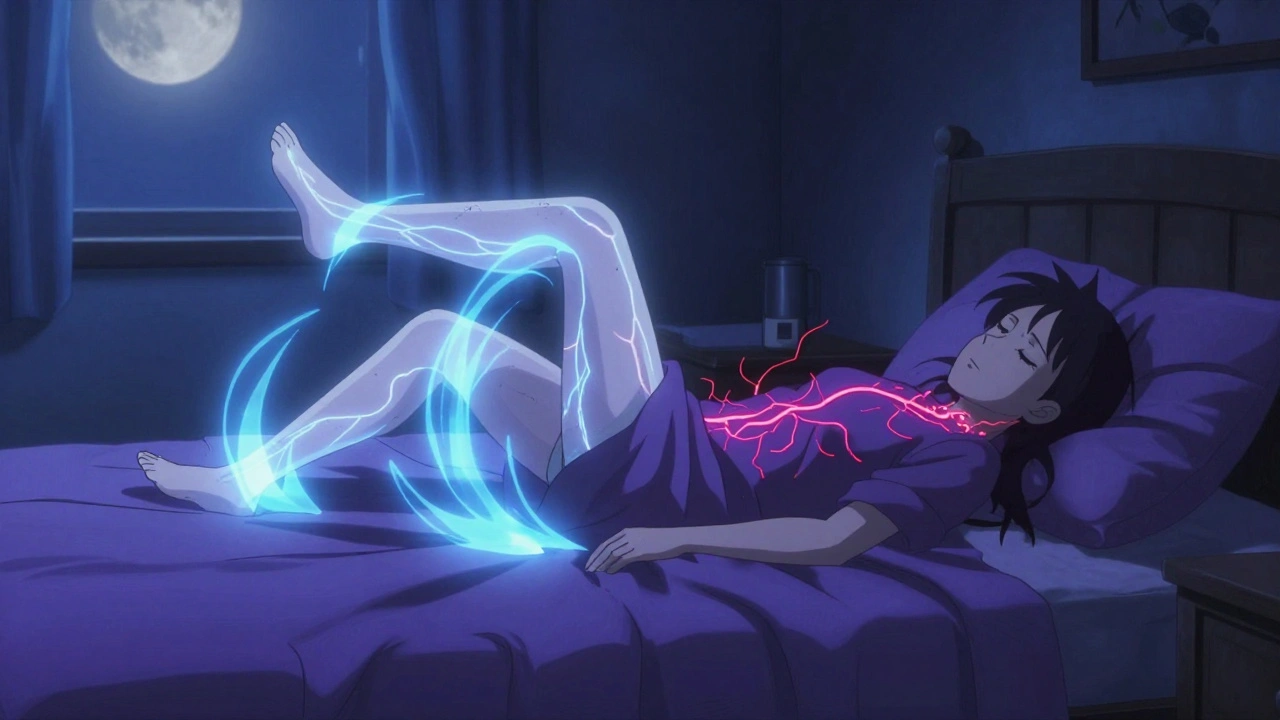
Restless Leg Syndrome is more than just an itchy or twitchy feeling in the legs at night. For millions of people, it’s a relentless urge to move - often described as crawling, aching, or electric shocks - that strikes when they’re trying to relax or sleep. It doesn’t go away with a stretch or a walk. It comes back, night after night, stealing rest and draining energy. For decades, the go-to solution was dopaminergic medications like pramipexole and ropinirole. But things have changed - dramatically.
Why Dopaminergic Medications Were Once the Gold Standard
In the early 2000s, drugs like Mirapex (pramipexole) and Requip (ropinirole) were hailed as breakthroughs. They worked fast. Within an hour, the restless urge would fade. Patients could finally sleep. Doctors prescribed them widely. By 2010, three out of every four new RLS prescriptions were for dopamine agonists. These drugs mimic dopamine, a brain chemical that helps control movement. In RLS, the brain’s A11 region - which sends signals to the spinal cord - doesn’t work right. Dopamine agonists fix that signal, at least temporarily. For people with occasional symptoms - say, two or three nights a week - they were perfect. Quick relief. No daily commitment.The Hidden Cost: Augmentation
But there was a catch. And it wasn’t mild. It was called augmentation. Augmentation means the symptoms get worse over time - not better. Instead of showing up only at night, they start in the afternoon. Then the early afternoon. Then all day. The tingling spreads from the legs to the arms. The urge becomes constant. The nights get worse, not better. A 2018 study in Neurology found that 40-60% of people on daily dopamine agonists developed augmentation within one to three years. By five years, rates climbed to 80%. That’s not a side effect. That’s a treatment failure. One patient, who asked to remain anonymous, said: “I started on Mirapex 0.25 mg for nighttime symptoms. Two years later, I couldn’t sit still past 2 p.m. My arms were shaking. I was exhausted. My doctor said, ‘Just up the dose.’ But the more I took, the worse it got.” And it’s not just the legs. Dopamine agonists also carry a risk of impulse control disorders. About 6% of users develop compulsive behaviors - gambling, shopping, binge eating. That’s 12 times higher than in the general population.The New First-Line Treatment: Alpha-2-Delta Ligands
By 2024, the American Academy of Sleep Medicine changed the rules. Dopamine agonists are no longer first-line. They’re second-line. The new standard? Alpha-2-delta ligands - gabapentin enacarbil (Horizant) and pregabalin (Lyrica). These drugs don’t touch dopamine. Instead, they calm overactive nerve signals. They don’t give you instant relief. It takes days, sometimes weeks. But once they work, they keep working - without worsening symptoms. A 2023 meta-analysis in JAMA Neurology compared pramipexole and pregabalin. At 12 weeks, both cut symptoms by about the same amount. But at one year? Pregabalin stayed strong. Pramipexole lost half its effect due to augmentation. Patients report better long-term satisfaction too. On Drugs.com, pregabalin scores 7.8 out of 10 for effectiveness. Pramipexole? Only 6.2. Why? Because people on dopamine agonists don’t just get side effects - they get worse symptoms.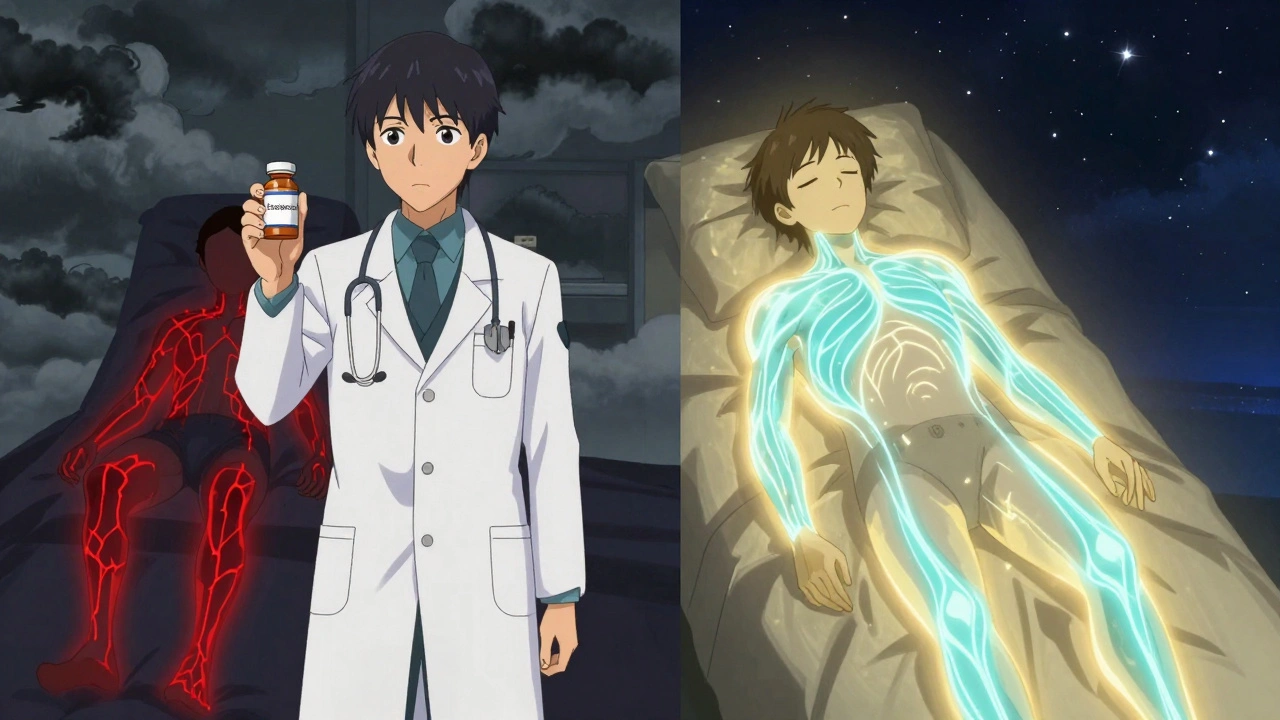
Other Options: Opioids, Iron, and Lifestyle
For some, even alpha-2-delta ligands aren’t enough. That’s where low-dose opioids come in. Oxycodone at 5 mg daily can reduce symptoms by 50-70%. But here’s the key: at these tiny doses, addiction risk is under 1%. A 2021 study in Pain Medicine found only 0.8% of RLS patients on low-dose opioids developed misuse - far lower than in chronic pain populations. Iron is another overlooked tool. About 30% of RLS patients have low iron stores in the brain, even if their blood iron looks normal. If your ferritin level is below 75 mcg/L, taking 100-200 mg of elemental iron daily for 12 weeks can improve symptoms by 35%. It’s not magic, but it’s real. Lifestyle changes matter too. Caffeine triggers symptoms in 80% of RLS patients. Alcohol worsens them in 65%. Cutting both out can reduce symptom severity by 20-30%. Good sleep hygiene - consistent bedtime, cool room, no screens before bed - helps more than most people realize.What to Do If You’re Already on Dopamine Agonists
If you’ve been on Mirapex, Requip, or Neupro for more than six months, you need to talk to your doctor - not because you’re doing something wrong, but because the science has moved on. Tapering off dopamine agonists isn’t easy. Stopping cold can cause rebound symptoms that are worse than before. The safest way? Reduce the dose by 25% every 1-2 weeks while starting gabapentin enacarbil or pregabalin. A 2023 study in Sleep Medicine showed 85% of patients successfully switched this way. Don’t panic. Don’t quit on your own. But do ask: “Is this still helping - or just masking the problem?”
Why the Shift Happened - And Why It Matters
The change wasn’t random. It was driven by hard data. Dr. John Winkelman at Massachusetts General Hospital led the research that exposed augmentation as a hidden epidemic. He didn’t just publish papers - he changed practice. The FDA added black box warnings. The European Medicines Agency set strict limits on treatment duration. The Restless Legs Syndrome Foundation updated its guidelines. The market followed. In 2010, dopamine agonists made up 75% of RLS prescriptions. In 2024? Just 20%. Alpha-2-delta ligands now lead the way. Sales for these drugs are projected to grow from $540 million in 2024 to nearly $900 million by 2030. Dopamine agonist sales? They’re expected to drop to $120 million. This isn’t just about drugs. It’s about understanding the disease. RLS isn’t caused by low dopamine. It’s caused by brain iron deficiency - which then disrupts dopamine. Giving more dopamine doesn’t fix the root problem. It just adds fuel to a broken system.What This Means for You
If you have RLS and you’re on a dopamine agonist:- Ask your doctor if you’re at risk for augmentation - especially if symptoms started earlier in the day or spread to your arms.
- Get your ferritin level checked. If it’s below 75, iron supplements may help.
- Track your caffeine and alcohol intake. Eliminating both could cut your symptoms by a third.
- Don’t assume your current med is still the best option. The guidelines changed. So should your treatment plan.
- Ask for gabapentin enacarbil or pregabalin first.
- Ask about iron testing before starting any drug.
- Know that quick relief isn’t always the best relief.
Are dopamine agonists still used for Restless Leg Syndrome?
Yes, but only as a second-line option. Dopamine agonists like pramipexole and ropinirole are no longer recommended as first-line treatment due to the high risk of augmentation - where symptoms worsen over time. They’re now reserved for patients with infrequent symptoms (less than 3 nights a week) or those who can’t tolerate other medications, and even then, only for short-term use under close supervision.
What is augmentation in Restless Leg Syndrome?
Augmentation is when RLS symptoms get worse because of long-term dopamine agonist use. Instead of appearing only at night, symptoms start earlier in the day - sometimes as early as mid-afternoon. The discomfort intensifies, spreads to the arms or torso, and occurs more frequently - often every night. It’s not a side effect. It’s a direct result of the medication itself.
What are the best medications for Restless Leg Syndrome now?
The current first-line treatments are alpha-2-delta ligands: gabapentin enacarbil (Horizant) and pregabalin (Lyrica). These drugs calm overactive nerves without triggering augmentation. They take days to weeks to work fully, but they provide stable, long-term relief. For patients who don’t respond, low-dose opioids or iron supplements (if ferritin is low) are viable alternatives.
Can iron supplements help with Restless Leg Syndrome?
Yes - but only if you’re iron deficient. About 30% of RLS patients have low iron in the brain, even with normal blood iron levels. If your serum ferritin is below 75 mcg/L, taking 100-200 mg of elemental iron daily for 12 weeks can reduce symptoms by up to 35%. Always get tested before starting iron therapy, and take it on an empty stomach with vitamin C for better absorption.
How long does it take for gabapentin enacarbil to work for RLS?
Gabapentin enacarbil typically takes 7-14 days to reach full effect, though some people notice improvement within a few days. Unlike dopamine agonists, which work within an hour, this drug builds up slowly in the system. That’s why it doesn’t cause augmentation - it’s not flooding the brain with dopamine. Patience is key. Don’t stop it if you don’t feel better right away.
Can lifestyle changes reduce RLS symptoms without medication?
Absolutely. Eliminating caffeine reduces symptoms in 80% of patients. Alcohol worsens them in 65%. Cutting both out can lower symptom severity by 20-30%. Regular exercise, consistent sleep schedules, and avoiding long periods of inactivity also help. These aren’t just tips - they’re evidence-backed strategies that work alongside or even replace medication for mild to moderate cases.







Comments (8)
Nicholas Swiontek
December 3, 2025 AT 16:49 PMFinally someone explains this without jargon! 🙌 I was on ropinirole for 3 years and thought I was just getting older - turns out my legs were staging a rebellion. Switched to pregabalin and now I sleep like a baby. No more 3 p.m. twitching panic. Life-changing. 😊
Shannon Wright
December 4, 2025 AT 07:31 AMIt is imperative that we recognize the paradigm shift in the clinical management of Restless Legs Syndrome. The historical reliance on dopaminergic agonists, while initially efficacious, has demonstrably led to iatrogenic exacerbation of symptoms - a phenomenon now widely documented in peer-reviewed literature. The emergence of alpha-2-delta ligands as first-line therapy represents not merely a pharmacological adjustment, but a fundamental reorientation toward addressing the underlying pathophysiology: cerebral iron dysregulation. This evolution in treatment guidelines reflects a maturation of our understanding, and clinicians must prioritize patient safety over short-term convenience. Long-term symptom control, without augmentation, is not merely preferable - it is ethically obligatory.
vanessa parapar
December 4, 2025 AT 15:55 PMOh honey, if you're still on Mirapex after six months, you're doing it wrong. 😅 I told my neurologist the same thing - he acted like I was asking for a unicorn. Iron levels? Check. Caffeine? Gone. Gabapentin? Started last week. Already better. You’re not ‘special’ - you just didn’t read the memo. The science’s been out since 2020. Stop blaming your legs and start blaming your doctor’s outdated playbook.
Ben Wood
December 4, 2025 AT 21:16 PMLet’s be real - dopamine agonists were never the answer. They’re like slapping a band-aid on a broken femur. And don’t even get me started on how the pharmaceutical industry pushed these drugs like candy… 6% impulse control disorders?! That’s not a side effect - that’s a crime. Pregabalin? Sure. Iron? Absolutely. But the real issue? Doctors still don’t test ferritin. They’re lazy. And you know what happens when doctors are lazy? People suffer. End of story.
Sakthi s
December 5, 2025 AT 12:04 PMIron test first. Always. Saved me. No meds needed after 3 months.
Rachel Nimmons
December 6, 2025 AT 02:15 AMThey say it’s about iron… but what if it’s the EMFs? Or the fluoridated water? Or the government’s secret mind-control chips in the streetlights? I’ve been tracking my symptoms since 2018. Every time they install a new smart meter near my house, the crawling starts. Pregabalin? Maybe it just masks it. I’m not taking anything that doesn’t address the root cause… whatever that is.
Abhi Yadav
December 6, 2025 AT 15:16 PMwe are all just neurons firing in the dark... dopamine agonists? they're just a mirror for our fear of stillness... maybe the legs aren't restless... maybe we are. i stopped fighting mine. started meditating. now i just... feel. the tingling. the ache. the silence. it's not a disease. it's a whisper.
Julia Jakob
December 7, 2025 AT 17:02 PMlol i was on pramipexole for 2 years and thought i was a champ for 'handling it'... then i quit cold turkey because my doctor was out of office and my legs turned into live wires. 3 days of pure hell. turned out i was already augmented. pregabalin? took 10 days to work. still worth it. caffeine is the devil. if you drink coffee after 2pm you deserve your suffering. also - my arms started tingling. i didn't believe it until i saw it. now i'm the weirdo who walks around the house at 4pm like a zombie. no regrets.