

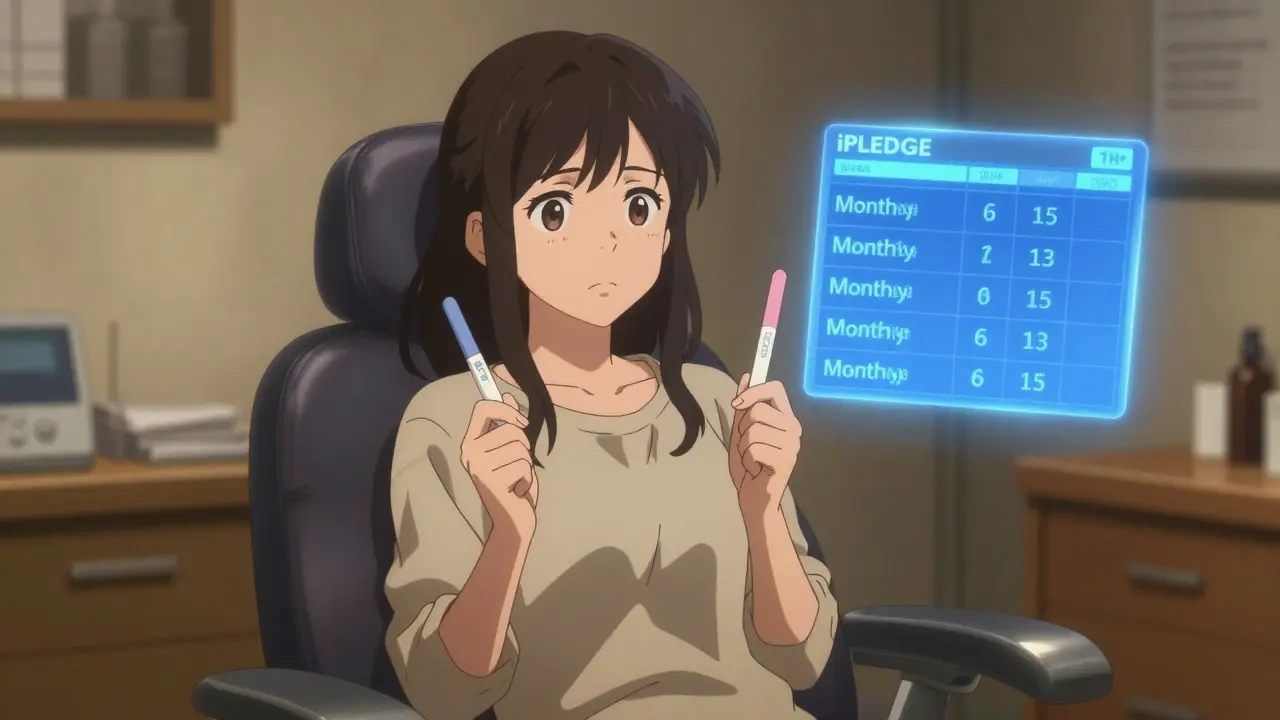
iPLEDGE Compliance Checker
Check Your iPLEDGE Requirements
What is iPLEDGE and why does it exist?
Isotretinoin is one of the most effective treatments for severe acne that hasn’t responded to antibiotics or other therapies. But it’s also one of the most dangerous drugs if taken during pregnancy. It can cause severe birth defects - including missing ear canals, brain damage, heart problems, and facial deformities. Because of this, the FDA created the iPLEDGE program in 2006. It’s not just a recommendation. It’s a legally required Risk Evaluation and Mitigation Strategy (REMS). Every single person involved - patient, doctor, pharmacist - must follow it. No exceptions.
Who has to follow iPLEDGE?
Everyone. Patients, prescribers, and pharmacies. You can’t get isotretinoin without being enrolled. Patients must register through their doctor’s office. Doctors must complete training and stay certified. Pharmacies have to activate their iPLEDGE accounts before they can fill any prescription. Even if you’re not pregnant, even if you’re male, you still have to go through the system. The rules just change based on your pregnancy potential.
What are the rules if you can get pregnant?
If you’re a female patient who can become pregnant, the requirements are strict - and for good reason. Before you start isotretinoin, you need two negative pregnancy tests. The second one must be done 1 to 3 days before you get your first prescription. Once you’re on the medication, you must take a pregnancy test every single month. You also have to use two forms of birth control at the same time. One pill isn’t enough. You need a second method - like condoms, an IUD, or implants. Each month, you must complete an online acknowledgment that you understand the risks. No skipping. No delays. If you miss a test or forget to check in, your prescription won’t be filled.
What are the rules if you can’t get pregnant?
If you’re male, postmenopausal, or have had a hysterectomy, the rules are simpler. You still need to register and complete the online education module. You still need to acknowledge the risks every month. But you don’t need pregnancy tests or birth control. The system still tracks you, but the burden is lighter. The November 2023 updates made this even easier: instead of monthly check-ins, you only need to confirm your understanding once when you enroll. After that, you’re good until your treatment ends.
Big changes in 2023 - what’s different now?
The iPLEDGE program was criticized for being too heavy-handed. Patients missed doses. Pharmacies couldn’t process prescriptions. Doctors spent hours on paperwork. In November 2023, the FDA made major changes to fix the worst parts:
- Home pregnancy tests are now allowed. You can use a test from the drugstore, but your doctor must verify the result before it counts.
- The 19-day lockout is gone. If you didn’t pick up your meds within 7 days, you used to be locked out for 19 days. Now, you can just request a new prescription.
- Monthly counseling is no longer required for low-risk patients. Men and postmenopausal women only need to confirm understanding once.
- CLIA-certified labs are no longer mandatory. You don’t need to go to a special lab for pregnancy tests anymore.
These changes cut down on delays and made the process less frustrating. But the core safety rules - no pregnancy during treatment - haven’t changed.
Why is iPLEDGE still controversial?
Even with the 2023 updates, people still have strong feelings. Some dermatologists say the program still wastes too much time. A 2021 survey found that 89% of dermatology practices spent 5 to 7 hours a week just managing iPLEDGE paperwork. That’s time not spent with patients. Others say the system still fails people in rural areas who can’t easily get to a clinic for monthly tests.
And despite all the rules, pregnancy cases still happen. Between 2009 and 2010, 190 pregnancies were reported among women taking isotretinoin - even with iPLEDGE in place. Critics argue the system isn’t foolproof. But the FDA says the alternative - no isotretinoin - means more people suffer from severe, disfiguring acne. The drug works when nothing else does. So the trade-off is clear: strict rules for a life-saving treatment.
What happens if you break the rules?
There’s no wiggle room. If a patient becomes pregnant while on isotretinoin, the doctor and pharmacy can be fined. The patient’s access to the drug is immediately cut off. The pharmacy can be permanently removed from the program. There’s no appeal. No second chance. The system is designed to be rigid because the consequences of failure are so severe.

How do you actually get started?
Here’s the real-world process:
- See your dermatologist. They’ll confirm you need isotretinoin and explain the risks.
- Complete the online education module (about 30 minutes). It covers birth control, pregnancy risks, and what to do if you miss a dose.
- Sign the electronic agreements - you’ll need to do this every month if you can get pregnant.
- If you can get pregnant: schedule your first pregnancy test, get two forms of birth control, and confirm both with your doctor.
- Your doctor will activate your iPLEDGE account and issue a prescription.
- Go to a participating pharmacy. They’ll check the iPLEDGE system before filling your script.
- Repeat monthly: test, attest, refill.
It’s not quick. But once you’re in the system, it becomes routine.
What if the system crashes or your pharmacy has issues?
It happens. iPLEDGE has had outages. Pharmacies sometimes can’t access the system. If your prescription is delayed, call the iPLEDGE helpline at 1-866-495-0654. It’s available 24/7. You can also check your status online at ipledgeprogram.com. Don’t wait until the last minute. Plan your appointments ahead. If you know you’ll be traveling, talk to your doctor about adjusting your schedule.
Is isotretinoin still worth it?
In 2022, over 1.2 million isotretinoin prescriptions were filled in the U.S. That number keeps growing. Why? Because for people with severe acne, it’s life-changing. It doesn’t just clear skin - it restores confidence, reduces scarring, and improves mental health. The iPLEDGE program is a barrier, but it’s a barrier designed to prevent irreversible harm. For many, the monthly check-ins are a small price to pay for clear skin and peace of mind.
What’s next for iPLEDGE?
The FDA says it’s still listening. Experts are already suggesting new tech - like biometric verification for pregnancy tests to stop fake results. Maybe in the future, apps will sync directly with your birth control tracker. Maybe AI will flag missed appointments before they happen. The goal isn’t to make the system perfect. It’s to make it as safe as possible, without making treatment impossible to access.


Comments (10)
Josh josh
January 27, 2026 AT 17:12 PMbro just got my first script and holy shit the portal is a nightmare. took me 45 mins just to upload my pregnancy test pic. why does this exist??
Karen Droege
January 28, 2026 AT 00:31 AMI’m a dermatology nurse in Vancouver and let me tell you - the 2023 updates saved our sanity. We used to spend 3 hours a day just chasing down iPLEDGE compliance. Now? We’re actually seeing patients. The system’s still clunky, but at least it’s not actively hostile anymore. 🙌
Aishah Bango
January 29, 2026 AT 15:51 PMIf you're a woman and you can't be bothered to use two forms of birth control, then you shouldn't be on this drug. Period. No excuses. This isn't about inconvenience - it's about preventing babies being born with no ear canals. Grow up.
Geoff Miskinis
January 29, 2026 AT 20:36 PMThe iPLEDGE program is a textbook example of regulatory overreach disguised as patient safety. The 89% of dermatologists spending 5-7 hours weekly on paperwork? That’s opportunity cost measured in human suffering. The FDA’s risk mitigation strategy is less a strategy and more a bureaucratic sledgehammer.
SWAPNIL SIDAM
January 31, 2026 AT 08:37 AMI’m from Delhi and my dermatologist told me to just get a test from the local pharmacy and send the photo. They didn’t even ask for a lab slip. I’m not sure if this is legal or not, but it’s what happens. Everyone’s just trying to get through this thing.
Angie Thompson
February 1, 2026 AT 05:56 AMI was on this for 8 months and honestly? It was worth every monthly test. My skin was so bad I cried in the mirror every day. Now? I don’t even recognize myself. 😭✨ iPLEDGE is annoying but it’s the price of not being the kid with the scarred face in yearbook photos. You got this!
shivam utkresth
February 2, 2026 AT 09:06 AMAs an Indian guy who got this script - y’all don’t realize how wild it is that we even have access to this drug here. In some parts of the country, you can’t even get a dermatologist. The fact that iPLEDGE works at all in places like Lucknow or Patna? That’s a miracle. Sure it’s a pain, but it’s not the system’s fault - it’s the infrastructure. We adapt.
Robin Van Emous
February 3, 2026 AT 09:31 AMI’m male, post-hysterectomy, and I still had to do the module. Twice. The pharmacy said the system glitched. So I did it again. Then they said my email wasn’t verified. Then I had to call the helpline. And it was 2 a.m. Why? Why does this exist? I’m not pregnant. I’m not even a woman. Why am I here?
Shweta Deshpande
February 4, 2026 AT 07:40 AMI just want to say - if you’re reading this and you’re scared to start isotretinoin because of iPLEDGE, I get it. I was terrified too. But listen - I had cystic acne for 7 years. I wore hats indoors. I turned down job interviews. I thought I’d never date. After 6 months on this, I got my first kiss. I got a promotion. I started hiking. The system is broken, yes. But the outcome? It’s worth every stupid monthly check-in. You’re not just treating acne. You’re reclaiming your life. And you’re not alone.
bella nash
February 5, 2026 AT 16:43 PMThe ethical imperative of preventing teratogenic harm necessitates a structured, non-negotiable regulatory framework. The autonomy of the individual must be subordinated to the sanctity of potential human life. To diminish the rigidity of iPLEDGE is to invite moral hazard. The burden of compliance is not a flaw - it is the necessary cost of ethical pharmaceutical stewardship.