

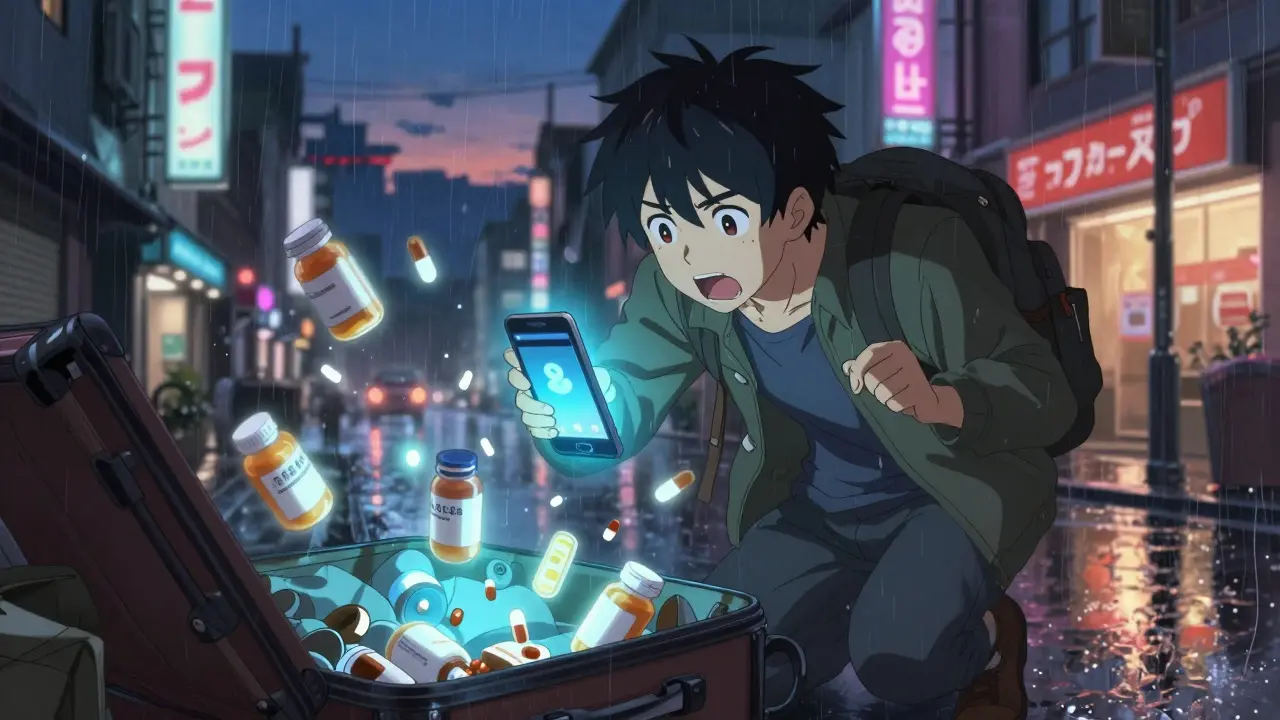
Running out of medication while traveling abroad isn’t just inconvenient-it can be dangerous. Whether your bag was stolen, your suitcase got lost, or you accidentally left your pills in a hotel room, you need to act fast. The good news? You can get replacements. The bad news? It’s not always easy, and doing it wrong could put your health at risk.
Don’t Panic-But Do Act Quickly
The first thing to do when you realize your meds are gone is stay calm. Panicking won’t help, but waiting will make things worse. If you’re traveling with insurance, call your provider’s 24/7 emergency line right away. Companies like Allianz, AIG, and World Nomads have medical assistance teams that can connect you with local doctors, pharmacies, and even arrange telehealth visits. In fact, 78% of travelers who use these services get their meds within 24 hours, according to UHC SafeTrip’s 2023 data. Those who try to handle it alone? Only 42% succeed.Check Your Travel Insurance Coverage
Not all travel insurance plans are created equal. Basic plans often cover only emergencies like broken bones or hospital stays-but not prescriptions. Look at your policy. If you have a comprehensive plan, you’re likely covered for up to $500-$1,000 in medication replacement. That’s enough to cover most common prescriptions like blood pressure pills, antibiotics, or asthma inhalers. But here’s the catch: you need to file a claim. That means getting a police report if your meds were stolen, or an airline baggage report if they were lost in transit. IATA requires these reports within 24 hours for flights and 21 days for baggage claims. Don’t skip this step-without documentation, your insurance won’t pay.Get a Copy of Your Prescription
This is the single most important thing you can do before you even leave home. Carry a printed copy of your prescription, including the generic name, dosage, and prescribing doctor’s contact info. Many countries won’t fill a foreign prescription-even if it’s legitimate. The International Pharmaceutical Federation found that 89% of countries prohibit pharmacies from honoring prescriptions from other nations. So if you’re in Thailand, Germany, or Brazil, and you walk into a pharmacy with a U.S. script, they’ll likely say no.Call Your Doctor Back Home
If you have a refill available, your U.S. pharmacy might be able to send it electronically. Chain pharmacies like Walgreens and CVS share systems and can transfer prescriptions between locations. But if you’re out of refills? Call your doctor. They can fax or email a new prescription to a local clinic or hospital. The problem? Only 63% of U.S. doctors are available for same-day emergency calls, according to MedAire’s 2022 study. If you’re in Europe or Canada, you might get lucky-many doctors there will work with your U.S. provider. But in Southeast Asia or parts of Africa? That’s unlikely.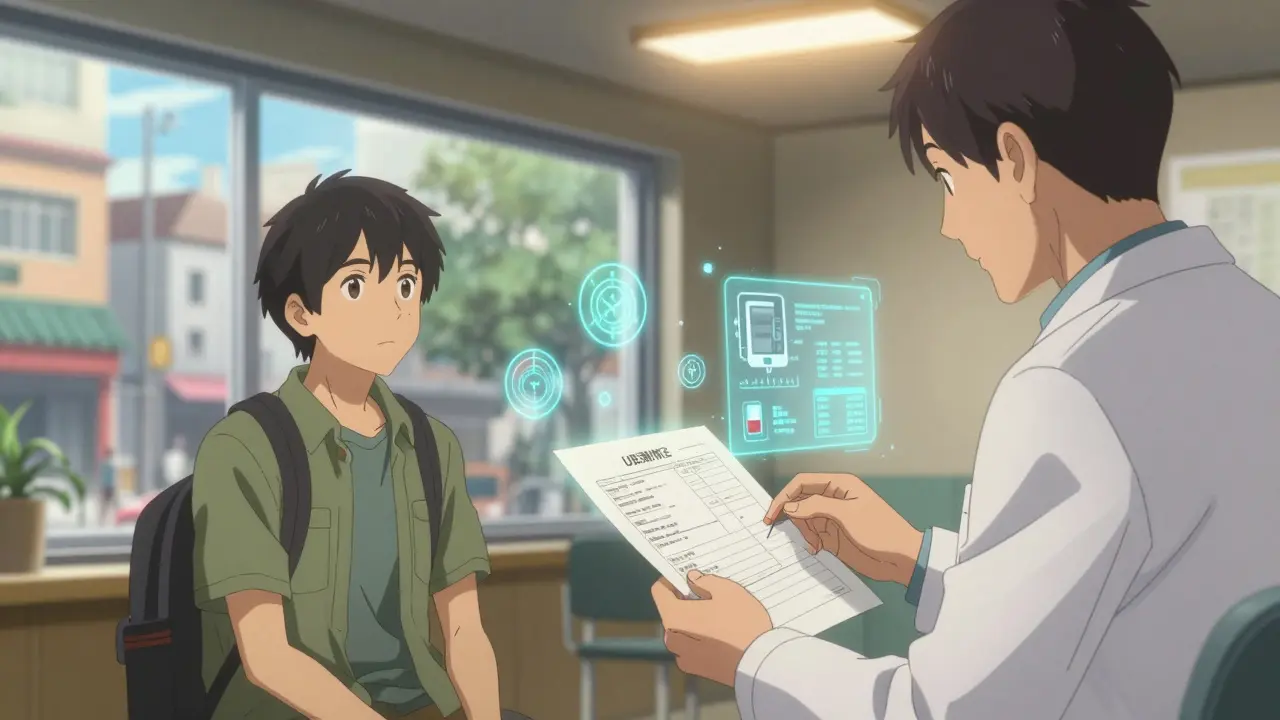
Visit a Local Doctor
Most countries will let you see a local physician who can write you a new prescription. But here’s the twist: many require an in-person visit, especially for chronic conditions like diabetes, heart disease, or depression. A 2022 survey by the American Medical Association found that 76% of international doctors won’t prescribe unfamiliar meds without seeing you. Bring your medical records, your doctor’s letter, and any lab results you have. If you’re diabetic and lost your insulin, don’t expect a local clinic to guess your dose. They’ll want to check your blood sugar, review your history, and maybe even run tests before writing anything.Watch Out for Counterfeit Drugs
This isn’t scare tactics-it’s a real threat. The World Health Organization estimates that 1 in 10 medications sold globally are fake. In parts of Southeast Asia and Africa, that number jumps to 30%. Fake pills can be harmless… or deadly. They might contain the wrong dose, no active ingredient, or even toxic chemicals. The CDC warns travelers to only buy meds from licensed pharmacies. Look for official signs, ask to see the pharmacy license, and avoid street vendors or unmarked shops. If the price seems too good to be true, it probably is.Controlled Substances Are a Whole Different Problem
If you’re taking Adderall, Ritalin, OxyContin, Vicodin, or any other Schedule II controlled substance, you’re in a tough spot. U.S. federal law doesn’t allow refills for these drugs-even in the U.S. And most countries won’t prescribe them to foreigners at all. The DEA’s 2023 guidelines make it clear: no exceptions. You can’t get a replacement in Mexico, Spain, or Japan. Your only option is to contact your doctor back home and ask if they can issue a new prescription that’s sent to a U.S. embassy or consulate. Some embassies have medical liaisons who can help, but it’s not guaranteed. In the worst-case scenario, you might have to wait until you return home. That’s why carrying extra supply is critical.Carry Medications in Original Containers
Never transfer pills to pill organizers or ziplock bags for international travel. Many countries require that medications be in their original bottles with the pharmacy label showing your name, the drug name, and the prescribing doctor. The International Society of Travel Medicine says 63% of countries enforce this rule. If you’re stopped at customs and your pills aren’t labeled, you could be detained, fined, or even arrested-especially if the drug is controlled in that country. For example, codeine is OTC in the UK but requires a prescription in the U.S. Pseudoephedrine (in cold meds) is banned in Thailand. Know your meds. Know the rules.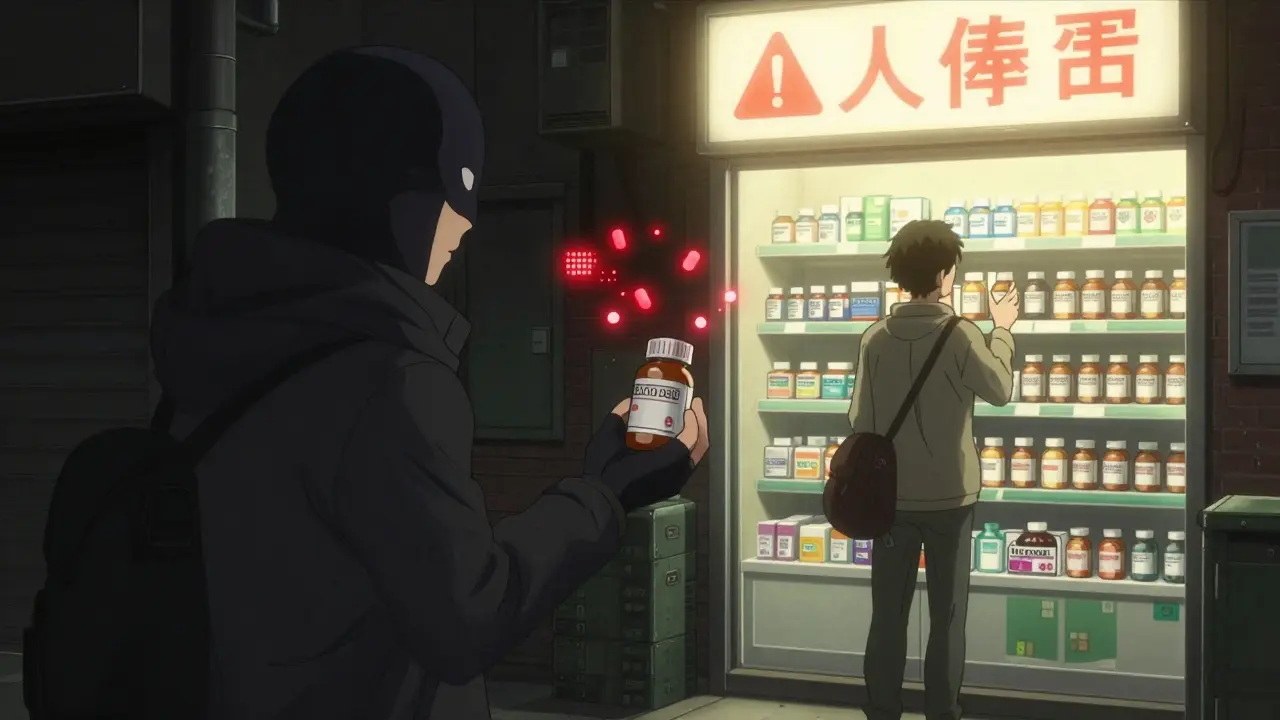
Use Digital Tools-But Don’t Rely on Them
Apps like Medisafe let you store digital copies of your prescriptions and track your doses. That’s helpful. But only 17% of countries accept digital prescriptions as official documentation. So use the app, but still carry printed copies. Some telehealth services like MyUSADr let U.S. travelers video-call licensed U.S. doctors who can prescribe non-controlled meds. But again-no controlled substances. The Ryan Haight Act still blocks that. So while tech helps, it’s not a magic fix.Prepare Before You Go
The best way to avoid this mess? Don’t let it happen. Before you leave:- Bring at least a 7-day extra supply in your carry-on. IATA says 1 in 150 checked bags get lost. Don’t risk your health on a suitcase.
- Get a letter from your doctor explaining your condition and listing all your meds by generic name. This is what 92% of travel medicine specialists recommend.
- Research your destination’s drug laws. The CDC’s Yellow Book 2024 has country-by-country rules. For example, melatonin is a prescription in the UK but sold freely in the U.S.
- If you need insulin or other temperature-sensitive meds, pack a cooling pack. The International Diabetes Federation found 41% of travelers lose effectiveness when meds overheat.
What If You’re in a Country With No Insurance or Doctor?
If you’re traveling without insurance and your meds are gone, you’ll need to pay out of pocket. Costs vary wildly:- Western Europe: $75-$150 for a typical prescription
- Southeast Asia: $40-$90
- Latin America: $120-$200
Final Tip: Know Your Limits
Some medications are just too risky to replace abroad. If you’re on complex psychiatric drugs, immunosuppressants, or chemotherapy, your best bet is to delay travel until you can get a solid backup plan. The European Centre for Disease Prevention and Control found that 22% of travelers on long trips (over 30 days) had medication access issues-and the most common problems were with heart, mental health, and diabetes meds. If your life depends on these drugs, don’t gamble. Bring extra. Bring documentation. Bring insurance.Can I get my prescription filled in another country?
Usually not. Most countries won’t fill foreign prescriptions. You’ll need to see a local doctor who can write a new one. Some countries, like those in the EU, have more flexible rules, but you still need proof of your medical condition and original prescription.
What if I lost my pills and don’t have a copy of my prescription?
It’s harder, but not impossible. Contact your doctor back home-they can often email a new copy. If that fails, visit a local clinic with any medical records you have. Travelers without documentation take 3.7 times longer to get replacements, according to a 2023 study in the Journal of Travel Medicine.
Can I buy over-the-counter meds abroad instead?
Only if the drug is available OTC in that country and it’s safe to substitute. For example, ibuprofen is widely available, but you can’t swap your blood pressure pill for a local painkiller. Never assume a similar-looking pill does the same thing. Check with a pharmacist or doctor first.
Are counterfeit drugs common abroad?
Yes, especially in Southeast Asia, Africa, and parts of Latin America. The WHO estimates 1 in 10 medications worldwide are fake, and up to 30% in high-risk areas. Always buy from licensed pharmacies, never street vendors. Look for official branding, sealed packaging, and verify the manufacturer.
What should I do if my meds were stolen on a flight?
Immediately report it to the airline’s baggage service office. You have 24 hours to file a claim under IATA rules. Get a written report. This is required for insurance claims and to prove the loss happened during transit. Don’t wait-delaying could void your coverage.

Comments (12)
Maggie Noe
January 10, 2026 AT 05:27 AMJust lost my insulin in Bangkok last year. Walked into a pharmacy, showed them my bottle, and they handed me the exact same thing for $8. No doctor, no paperwork. Just a guy behind the counter who spoke zero English but knew what insulin looked like. 🤷♀️💊
Jacob Paterson
January 12, 2026 AT 00:40 AMOf course you can just ‘walk into a pharmacy’ - until you’re the one holding a prescription for Adderall and the pharmacist calls the police. You think Thailand gives a damn about your ADHD? They lock people up for less. Stop being naive. This isn’t a travel blog, it’s a legal minefield.
Jeffrey Hu
January 12, 2026 AT 07:19 AMPeople don’t realize that 89% of countries don’t recognize foreign scripts because of liability laws, not bureaucracy. It’s not about trust - it’s about malpractice insurance. If you show up with a US script for gabapentin in Japan and something goes wrong, who’s liable? You? The pharmacist? The US doctor? No one. So they say no. It’s not personal. It’s legal.
Pooja Kumari
January 13, 2026 AT 01:21 AMI just want to say… I cried when I lost my antidepressants in Morocco. I was alone, it was raining, and I had no idea where to go. I ended up at this tiny clinic run by a woman who spoke French and Arabic and somehow understood my panic. She gave me a sample pack and said, ‘You are not alone.’ I still think about her. If you’re reading this and you’re in that situation - you’re not alone. Keep going. 💔🫂
Angela Stanton
January 14, 2026 AT 05:39 AMLet’s be real - the ‘bring extra pills’ advice is useless if you’re on a 6-month trip and your insurance only covers 30 days. Also, cooling packs? LOL. I packed one. It melted in 3 hours in Dubai. Now I just carry my meds in my bra. No joke. It’s the only way to keep them cool and safe from TSA. 🤫
Johanna Baxter
January 15, 2026 AT 07:59 AMmy heart is literally pounding rn because i lost my heart meds in italy and i was so scared i just sat on a bench and cried for 20 minutes. nobody gets it. nobody.
Matthew Maxwell
January 15, 2026 AT 15:13 PMIt’s not rocket science. If you’re taking controlled substances, you shouldn’t be traveling unless you’re prepared to be without them. Period. This isn’t a ‘hack’ article - it’s a warning. Your mental health is not a vacation perk. You don’t get to risk your life because you forgot to pack an extra bottle. This is basic responsibility.
Diana Stoyanova
January 16, 2026 AT 17:29 PMListen. I’m a nurse and I’ve helped travelers in 14 countries. Here’s the truth: the real hero isn’t the insurance company, it’s the local pharmacist who takes a second to look at your bottle and says, ‘I’ve seen this before.’ They know the generic names. They know the colors. They know the shapes. Don’t treat them like clerks - treat them like lifesavers. And bring a smile. It goes further than any document.
Heather Wilson
January 18, 2026 AT 09:11 AMWhile the article provides a comprehensive framework for medication replacement abroad, it fails to address the socioeconomic disparities in access. For instance, in Latin America, the cost differential between branded and generic pharmaceuticals is not merely a matter of pricing - it reflects systemic underinvestment in public health infrastructure. Moreover, the assumption that travelers possess the cognitive bandwidth to navigate bureaucratic systems while experiencing physiological distress is a form of epistemic privilege. The data cited, while statistically significant, does not account for cultural competency gaps between foreign providers and patients, nor does it consider the psychological toll of medical uncertainty in non-native linguistic environments. A truly holistic approach would integrate trauma-informed communication protocols into international medical assistance frameworks.
Gregory Clayton
January 20, 2026 AT 09:08 AMU.S. citizens think they can just walk into any country and demand their meds like it’s a Starbucks. Newsflash: you’re a tourist. Not a diplomat. Stop acting like the world owes you your prescriptions. If you can’t pack an extra month’s supply, maybe don’t leave the country. We’re not your pharmacy.
tali murah
January 21, 2026 AT 20:47 PMLet me just say - if you’re taking psychiatric meds and you think ‘just call your doctor’ is a solution, you’ve never tried calling a U.S. psychiatrist at 3 a.m. in Germany. They don’t answer. They don’t care. And if you’re on something like lithium? Good luck. That’s not a pill - it’s a legal document. I’ve been there. I’ve sat in emergency rooms in Prague and Madrid holding my bottle like a holy relic, begging for someone to understand that I’m not a drug seeker - I’m a person who needs to live. The system fails us. Every. Single. Time.
Jerian Lewis
January 23, 2026 AT 05:12 AMDon’t forget to check if your meds are banned in your destination. I once got pulled over in Singapore for carrying codeine. They didn’t arrest me - but they made me watch a 45-minute video about how drugs destroy families. I’ve never felt so small. Bring documentation. Know the laws. And for god’s sake, don’t be the person who ruins it for everyone else.