

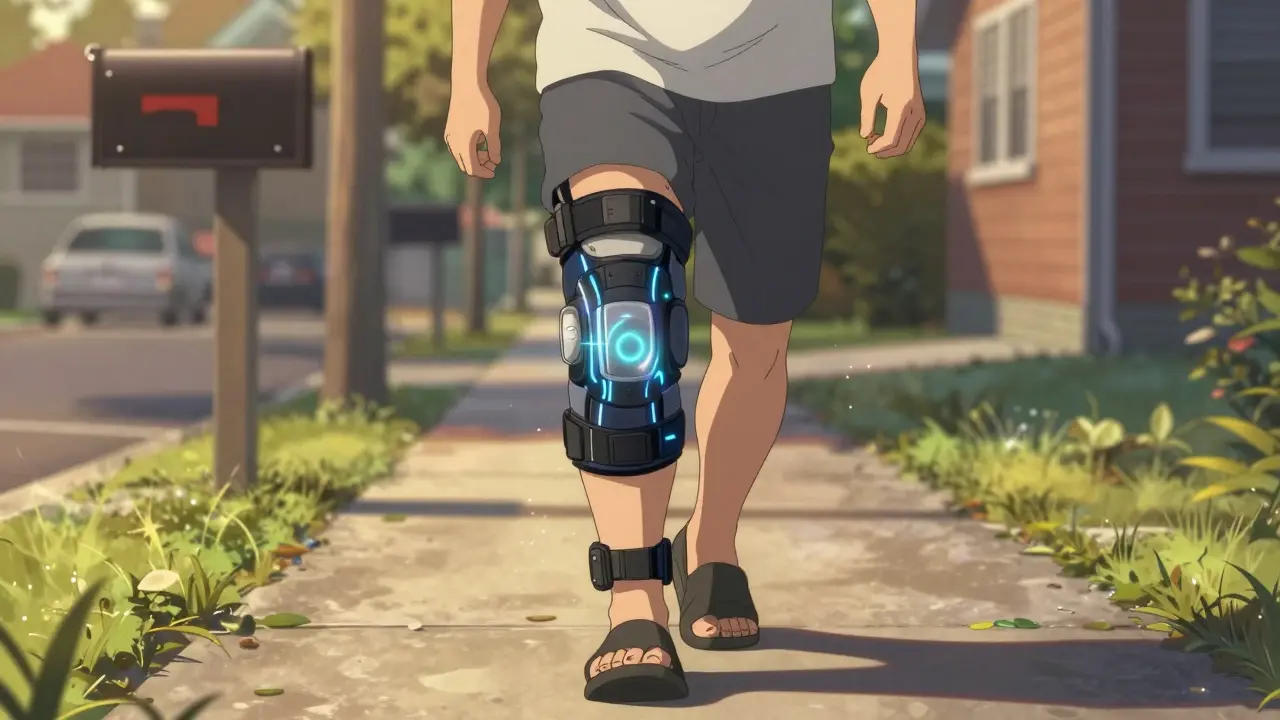
When your knee hurts just to walk to the mailbox, you’re not alone.
Over 250 million people worldwide deal with knee osteoarthritis - and in the UK alone, nearly 1 in 5 adults over 45 report daily knee pain. It’s not just aging. It’s cartilage wearing down, bones grinding, inflammation flaring. The good news? Surgery isn’t your only option. In fact, most experts agree you should try knee osteoarthritis pain management first - and three approaches stand out: bracing, injections, and exercise.
Bracing: The Silent Hero That Shifts the Load
If your knee pain is worse on one side - usually the inner side - an unloader brace might be the missing piece. These aren’t your grandfather’s bulky metal supports. Modern unloader braces use lightweight materials and hinge systems to gently shift pressure away from the damaged part of your knee. Think of it like putting a wedge under a wobbly table. It doesn’t fix the leg, but it takes the strain off the broken part.
Studies show these braces can reduce pain by 30-45% on standard pain scales. One 2023 analysis of 139 trials found they ranked highest for improving both pain and movement. That’s better than most pills. They’re especially effective if you have medial compartment OA - which affects 85% of people with knee osteoarthritis.
But they’re not magic. You need a proper fit. A certified orthotist should measure you. Off-the-shelf braces often cause more irritation than relief. Costs range from £250 to £1,000, and while some private insurers cover them, NHS provision is limited. Most people need 2-3 weeks to get used to wearing one. Skin redness? Common. But if it turns into open sores, stop and get it adjusted.
Injections: Fast Relief, But Not Forever
When the pain spikes - maybe after a bad day on your feet or a cold snap - injections can give you breathing room. Three types are commonly used:
- Corticosteroids: Cheap, quick, and strong. A single shot costs around £50-£150 and can knock down inflammation for 4-12 weeks. But use them too often - more than 3-4 times a year - and you risk damaging the cartilage further.
- Hyaluronic acid: Often called "gel shots," these mimic the natural lubricant in your joint. A full course is 3-5 weekly injections costing £500-£1,200. Newer versions like Gel-Syn 3 now last up to 22 weeks. But studies show they’re only slightly better than placebo for many people.
- PRP (Platelet-Rich Plasma): Your own blood, spun down to concentrate healing cells. Costs £500-£2,000 per shot. Evidence is mixed. Some patients swear by it. Others feel nothing. It’s not routinely covered by insurance.
The biggest downside? Pain during the shot. One survey found 57% of patients said the injection itself was worse than the knee pain. And relief is temporary. If you’re relying on injections alone, your muscles weaken from lack of movement. That’s why experts warn: injections should be a pause button, not the main track.

Exercise: The Only Treatment That Gets Stronger Over Time
Here’s the truth no one tells you: exercise doesn’t just help your knee - it rebuilds your whole body. Water-based workouts like swimming or aqua aerobics reduce joint load by up to 80%. One 12-week study showed a 28.7% drop in pain on the visual scale - better than land-based exercise. But even walking, cycling, or seated leg lifts work if you do them right.
What matters most isn’t intensity. It’s consistency. Two to three sessions a week, 45-60 minutes each. Focus on three things:
- Strengthening: Quad and hamstring exercises. Straight leg raises, seated leg presses, step-ups. Strong muscles act like shock absorbers.
- Flexibility: Daily stretches. Even 5 minutes of calf and thigh stretches can improve knee motion by 8 degrees over 6 weeks.
- Balance: Single-leg stands, heel-to-toe walks. Falls are a major risk with weak knees.
People who stick with it for a year see 32% better function than those who only get injections. And here’s the kicker - 63% of those who stick with exercise say their hips, back, and ankles feel better too. That’s because knee OA doesn’t live in isolation. It’s part of a whole-body problem.
The hard part? Keeping up. Dropout rates hit 35% after six months. That’s why supervised programs - even just 4-6 sessions with a physio - make all the difference. The Arthritis Foundation’s free online exercise videos are a great start. No gym needed.
Which One Should You Choose? The Real Answer
There’s no single best option. But there is a best combination.
Think of it like this:
- Use bracing when you’re out walking, shopping, or standing for long periods. It gives you immediate, passive support.
- Use injections when you’re having a flare-up - maybe after gardening or a long trip. Don’t use them as a crutch. Save them for when pain is unbearable.
- Use exercise every single day, even on rest days. Just 10 minutes of stretching or seated leg lifts counts.
Experts like Dr. Tuhina Neogi say the most effective strategy is combining all three. Bracing lets you move without pain. Injections give you a reset when things flare. Exercise rebuilds your strength so you don’t need them as much over time.
One 2023 study showed patients using all three had 40% fewer doctor visits and 50% less reliance on painkillers after 12 months. That’s not just pain relief - that’s life improvement.
What Doesn’t Work (And Why You Should Skip It)
Not everything marketed as a solution helps. Here’s what to avoid:
- TENS units: The American Academy of Orthopaedic Surgeons says evidence is too weak to recommend them.
- Lateral wedge insoles: They’re cheaper than braces, but studies show they reduce knee stress by only 5-10% - not enough to matter.
- Excessive rest: Sitting still makes your muscles weaker and your joint stiffer. Movement is medicine.
- Unproven supplements: Glucosamine and chondroitin? Major trials show no real benefit over placebo. Save your money.

Real People, Real Results
On Reddit, one user wrote: "I got a brace, did 3 cortisone shots, and started walking 20 minutes a day. After 4 months, I didn’t need the brace anymore. My knee felt stronger than it had in 10 years." Another on Healthgrades said: "I tried injections for a year. Each time, relief lasted less. Then I started pool classes. Now I hike. I didn’t know my knee could feel like this again." The data backs them up. People who combine exercise with bracing are 3 times more likely to avoid surgery in the next 5 years than those who only take pills or get shots.
Getting Started: Your First 30 Days
Don’t wait for perfection. Start small.
- Week 1-2: Walk 10 minutes a day. Use a brace if you need it. Do 3 sets of seated leg lifts (10 reps each). No pain beyond mild discomfort.
- Week 3-4: Add 5 minutes to your walk. Try 2 water-based sessions if you have pool access. Stretch quads and hamstrings daily - hold each stretch 30 seconds.
- Week 5-6: Aim for 3 exercise sessions a week. Talk to your GP about a brace referral or ask about a cortisone shot if pain is blocking your movement.
Track your progress. Note when pain improves, when it flares, what made it better. You’re not just treating a knee. You’re learning your body.
What Comes Next?
Research is moving fast. Smart braces with sensors that give feedback on your gait are already here. Personalized exercise plans based on your knee biomechanics are coming to clinics soon. But the core hasn’t changed: movement, support, and smart timing still win.
If you’re still in pain after 3 months of consistent effort, talk to a physiotherapist or rheumatologist. There are other tools. But for most people, bracing, injections, and exercise - done right - are enough to live well without surgery.
Can I wear a knee brace all day?
Yes, if it fits well and doesn’t cause skin irritation. Most people wear braces during activity - walking, standing, shopping - and take them off at night. Wearing one 24/7 can lead to muscle weakness. Use it as a tool, not a crutch.
How often can I get knee injections?
Corticosteroid injections should be limited to 3-4 times per year in the same knee. Too many can damage cartilage. Hyaluronic acid injections are usually given as a series of 3-5 shots, once a week, and repeated no more than once a year. PRP has no strict limit, but most doctors recommend waiting at least 6 months between treatments.
Is exercise safe if my knee is swollen?
Yes - but modify it. Avoid high-impact moves like running or jumping. Stick to gentle motion: seated leg circles, ankle pumps, or water walking. Movement helps reduce swelling by improving circulation. If swelling is severe or hot to the touch, see a doctor first - it could be infection or gout.
Do I need a referral for a knee brace or injection?
For NHS patients, you’ll usually need a GP referral for a brace or injection. Private clinics can offer them without one, but check insurance coverage. Some orthotists accept self-referrals for braces if you’ve been diagnosed with OA. Always get a proper diagnosis first - not all knee pain is osteoarthritis.
Will losing weight help my knee pain?
Absolutely. Every pound lost reduces 4 pounds of pressure on your knee. Losing just 10 pounds can cut pain by 50% in many people. Weight loss combined with exercise is the most powerful non-surgical combo for long-term relief.
What if nothing works? When should I consider surgery?
Surgery - like a total knee replacement - is usually considered when pain stops you from sleeping, walking, or doing daily tasks, even after 6-12 months of consistent non-surgical treatment. If you’re still in severe pain despite bracing, injections, and exercise, it’s time to talk to an orthopedic surgeon. But remember: most people who try the full combo never need it.
If you’re struggling with knee pain, you don’t have to just live with it. The tools to feel better are here - and they’re not expensive, not risky, and not magic. Just consistent.







Comments (14)
Kevin Narvaes
January 21, 2026 AT 03:08 AMbro i just let my knee rot and now i walk like a penguin with a vendetta. why fight it? pain is just life’s way of saying ‘sit down and contemplate your choices’.
Sangeeta Isaac
January 22, 2026 AT 21:34 PMsooo… i got a brace, did 3 cortisone shots, and started walking 20 mins a day. after 4 months? i didn’t need the brace anymore. my knee felt stronger than it had in 10 years. also, my cat now respects me. who knew?
Alex Carletti Gouvea
January 24, 2026 AT 16:26 PMthis is why america’s healthcare is broken. you need a $1000 brace just to walk to the fridge? in my day, we just sucked it up and walked uphill both ways.
Philip Williams
January 25, 2026 AT 13:30 PMThe empirical evidence supporting a multimodal approach-bracing, targeted injections, and consistent therapeutic exercise-is both statistically significant and clinically actionable. It is imperative that patients prioritize longitudinal adherence over transient relief. This is not anecdotal-it is biomechanically validated.
Ben McKibbin
January 27, 2026 AT 13:15 PMI’ve been walking with a cane for 3 years. Got a brace last spring-felt like a robot at first. Then I started doing seated leg lifts while watching Netflix. Six months later, I hiked a mountain. Not because I’m special. Because I didn’t quit. You don’t need magic. You need minutes.
Melanie Pearson
January 28, 2026 AT 17:26 PMLet me be clear: this article is dangerously misleading. You’re normalizing chronic pain as something you ‘manage.’ What about systemic neglect? Why are we pushing $2000 PRP shots on working-class people while insurance denies physical therapy? This isn’t wellness-it’s capitalism in knee pads.
Jerry Rodrigues
January 28, 2026 AT 19:48 PMbraces suck at first but they work. i wore mine to the grocery store every day. after a month i forgot i had it on. now i walk like a normal human. no drama. just consistency.
Uju Megafu
January 30, 2026 AT 06:59 AMI KNEW IT. I TOLD YOU ALL. THIS IS WHY WE NEED TO BAN OSTEOPOROSIS AND MAKE THE GOVERNMENT PAY FOR EVERYTHING. MY KNEE HURTS BECAUSE CAPITALISM IS A LIE AND THE DOCTORS ARE IN ON IT. I’M TAKING A 3000 DOLLAR PRP SHOT AND I’M GOING TO POST A TIKTOK ABOUT IT.
Jarrod Flesch
January 31, 2026 AT 09:14 AMMate, I’ve been there. Got the brace, did the pool sessions, skipped the injections. Now I’m hiking in Tasmania. 🏔️💧 Just start small. Even 5 mins a day counts. You’ve got this. (And yes, the water ones are magic.)
Kelly McRainey Moore
February 2, 2026 AT 03:27 AMi started with just 10 minutes of leg lifts while watching my favorite show. now i’m dancing with my grandkids. no big deal. just baby steps. you can do it too :)
Stephen Rock
February 2, 2026 AT 19:21 PMexercise? really? i got a knee replacement at 48. you people are just delaying the inevitable. stop pretending you can outsmart biology. this is just a fancy ad for physios.
Amber Lane
February 4, 2026 AT 19:00 PMI tried the brace. Hated it. Then I started walking. Now I don’t need it.
Gerard Jordan
February 5, 2026 AT 18:35 PMHey everyone 👋 just wanted to say: you’re not alone. I started with 3 minutes of seated leg raises. Now I walk my dog 2 miles. It’s not about perfection. It’s about showing up. 💪❤️ And if you need a buddy to text, I’m here.
michelle Brownsea
February 7, 2026 AT 02:30 AMI find it deeply concerning that this article promotes the notion that ‘consistency’ is a sufficient substitute for medical intervention. The data is cherry-picked, the language is manipulative, and the implication that patients can ‘fix’ their OA through willpower alone is not only scientifically unsound-it is ethically irresponsible. Where is the discussion of structural inequality in access to orthotists? Of insurance denials? Of the psychological toll of chronic pain? This isn’t empowerment-it’s victim-blaming dressed in yoga pants.