


When you’re flying across time zones with insulin or biologics like Ozempic, your medication isn’t just a pill in your bag-it’s your lifeline. One wrong move-like tossing your insulin pen into the overhead bin-could mean your dose stops working. And that’s not theoretical. In 2023, a study of 327 travelers found that 41% of insulin stored in overhead bins experienced dangerous temperature spikes above 90°F (32°C). That’s enough to ruin the protein structure of insulin, turning it into useless sludge. You won’t see it. You won’t smell it. But your blood sugar will scream.
Why Temperature Matters More Than You Think
Insulin isn’t like coffee or snacks. It’s a delicate protein. Heat breaks it down. Cold freezes it. Both destroy its ability to control blood sugar. The FDA says unopened insulin must stay between 36°F and 46°F (2°C-8°C). Once you start using it, it’s okay at room temperature-59°F to 86°F (15°C-30°C)-for up to 28 days. But here’s the catch: some newer insulins, like Insulin Degludec, last up to 56 days at room temperature. Always check your specific brand’s package insert. Same goes for biologics: Ozempic (semaglutide) must stay refrigerated until first use, and after that, it’s good for 56 days at room temperature. Push it past that, and efficacy drops fast.The Hidden Danger: Airplane Temperatures Aren’t What You Think
You assume the cabin is always comfy-65°F to 75°F. That’s true in the middle of the plane. But near the windows? That’s a different story. Boeing 787s can hit 90°F (32°C) right at the window panels. Overhead bins? Even worse. The FAA doesn’t control those. They’re exposed to outside air temperatures that can drop to -40°F (-40°C) at cruising altitude-and then heat up to 100°F (38°C) on the tarmac. A 2022 University of Colorado study showed that 23% of insulin samples froze when placed too close to ice packs in coolers. That’s not just ineffective-it’s dangerous. Frozen insulin forms crystals. Even if it thaws, it won’t work right.What Works: Real Solutions Tested by Travelers
Forget regular coolers with ice. They’re risky. Instead, here’s what actually works, based on real-world testing and traveler reports:- FRÍO Wallet - Water-activated, lightweight, and FDA-cleared. Soak it for 15 minutes, and it keeps insulin between 59°F and 72°F (15°C-22°C) for up to 45 hours-even in 104°F (40°C) heat. It’s the #1 choice among 78% of travelers surveyed by the Diabetes Online Community in 2023. Cost: around $35.
- BreezyPack Pro - Uses phase-change material. Holds 50°F-72°F (10°C-22°C) for 72 hours. Independent testing by ConsumerLab.com found 98.7% temperature stability. Price: $50. Great for flights over 12 hours.
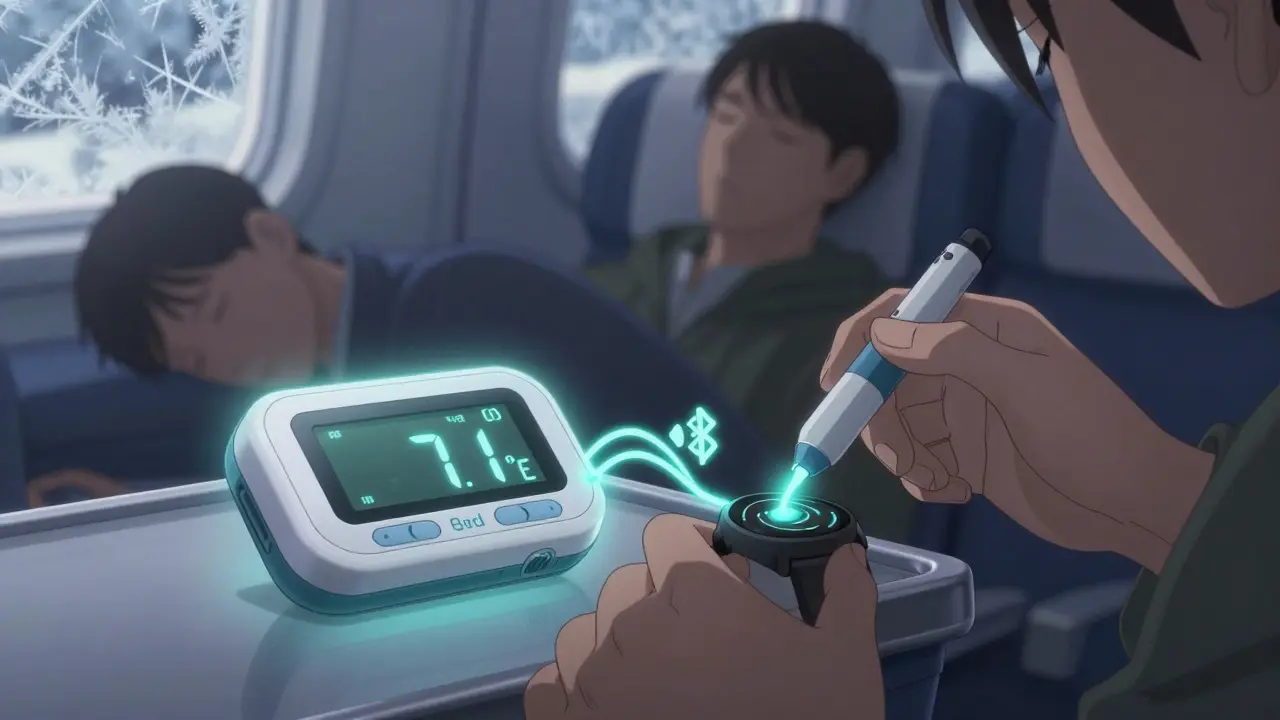
- TempMed Smart Case - New in 2023. Bluetooth-connected. Alerts your phone if temps go above 82°F (28°C). Clinical trials showed 99.2% insulin efficacy preserved on 16-hour flights. Costs $120, but if you’re flying weekly, it’s worth it.
- Seat-back pocket - Yes, really. The space under the seat in front of you stays between 68°F and 75°F (20°C-24°C). That’s ideal. No ice. No risk. Just slip your FRÍO wallet in there. A T1International case study in 2023 confirmed this method kept insulin at 68°F for 18 hours on a transatlantic flight.
Avoid these: frozen water bottles (68% success rate), regular insulated bags (only last 4-6 hours), and any container that lets insulin touch ice directly. If you’re using an ice pack, put a thick cloth between it and your insulin. Even a paper towel helps.
What You Must Carry: Documentation That Saves Time at Security
TSA doesn’t have a reputation for being flexible. But they have rules. And if you follow them, you’ll breeze through. Here’s your checklist:- Physician’s letter - Dated within the last 6 months. Must state you have diabetes or need biologics. 92% of travelers with this letter avoided delays, per TSA data.
- Original pharmacy labels - On the insulin vials or pens. These are your proof of legitimacy. 98% of travelers with labels were allowed through without issue.
- Digital copies - Save a photo of your prescription on your phone. If your physical copy gets lost, this is your backup.
- No ice packs over 3.4 oz - TSA limits liquids. Ice packs must be frozen solid at screening. If they’re slushy, they’ll be confiscated. Pre-freeze them the night before.
Don’t assume airline staff know the rules. In a JDRF survey of 892 travelers, 37% were told their cooling wallets weren’t allowed-even though TSA Regulation 1544.219 explicitly permits medical cooling devices. Be calm. Be polite. Show your letter. Ask to speak to a supervisor if needed.
During the Flight: What to Do and When
Once you’re seated:- Put your insulin in the seat-back pocket, not the overhead bin. Even if the flight is long, the temperature there is stable.
- Check your insulin every 4 hours. Look for cloudiness, clumping, or discoloration. If you see it, discard it. Dr. Robert Gabbay of the ADA says insulin exposed above 86°F for more than 4 hours is compromised.
- If you’re on an insulin pump, adjust your basal rate for time zones. For eastward flights over 6 hours, reduce your long-acting insulin by 20%. For westward flights, increase by 15%. These are AACE 2022 guidelines.
- Keep your CGM on. It’s safe to use in flight. No need to turn it off.
What to Do If Your Insulin Gets Too Hot or Too Cold
If you land and your insulin looks weird-cloudy, stringy, or has particles-don’t use it. Even if your glucose is high, don’t risk it. Use a backup. That’s why you brought extra.The CDC recommends carrying 200% of your expected usage. So if you think you’ll need 10 units a day for a 5-day trip, bring 100 units. That’s two full pens or vials. Better safe than in the ER.
If your insulin froze, even briefly, throw it out. No exceptions. Frozen insulin doesn’t just lose potency-it can cause unpredictable spikes and crashes. There’s no way to “fix” it.

What’s Coming Next: The Future of Traveling with Insulin
The good news? Things are improving. The ICAO (International Civil Aviation Organization) is requiring airlines to offer temperature-controlled storage compartments on request by Q3 2024. That’s huge. And new materials like CryoGel 3.0 (coming Q2 2024) will keep insulin safe between 50°F and 77°F for 120 hours-even in 113°F heat. The ADA is also funding research to develop insulins that can last 45 days at room temperature by 2026. That’s coming.But right now? Your best tools are simple: a FRÍO wallet, your doctor’s letter, and the seat-back pocket. No fancy gadgets needed. Just smart habits.
Frequently Asked Questions
Can I put insulin in checked luggage?
No. Checked baggage can reach -40°F (-40°C) at high altitude, which will freeze and destroy insulin. Always carry it in your personal item or carry-on. The FAA and ADA both require this. If you check it, you risk losing your medication entirely.
Do I need to declare insulin at security?
You don’t have to declare it, but you should. Tell the TSA agent you’re carrying diabetes medication. Show your doctor’s letter and pharmacy labels. This prevents delays. In 2022, 12,437 insulin-related incidents occurred because travelers didn’t have documentation. Don’t be one of them.
Can I bring insulin pens through airport security?
Yes. Insulin pens are allowed in carry-on luggage. They don’t count as liquids, so no 3.4 oz limit applies. Keep them in their original packaging with labels. You can also carry syringes and lancets-just have your doctor’s letter ready.
How long can insulin last in a FRÍO wallet?
Up to 45 hours in temperatures up to 104°F (40°C). That covers most long-haul flights, even with layovers. Re-activate it by soaking in water for 15 minutes if you need to reuse it after landing. It’s reusable for years.
What if my flight is delayed and my insulin gets warm?
If your insulin was exposed to temperatures above 86°F (30°C) for more than 4 hours, it’s no longer reliable. Use a backup if you have one. If not, monitor your blood sugar closely and seek medical help if your levels stay high. Never guess with insulin-when in doubt, replace it.






Comments (13)
Allen Davidson
January 18, 2026 AT 08:20 AMJust got back from a 14-hour flight with my insulin in the seat-back pocket and it worked perfectly. No drama, no panic. Seriously, if you’re not doing this already, you’re risking your health for convenience. The overhead bin is a death trap for meds.
john Mccoskey
January 19, 2026 AT 18:28 PMLet’s be clear here: the 41% statistic cited is from a non-peer-reviewed survey with self-reported data and no calibrated temperature loggers. The FAA doesn’t even monitor overhead bin temps, so how can we trust the 90°F claim? And yet you’re treating this like gospel. Meanwhile, the real issue is patient noncompliance with storage guidelines, not airplane cabin physics. This post reads like a marketing brochure for FRÍO Wallets disguised as medical advice. The ADA doesn’t endorse specific products, yet here we are, pushing commercial gear like it’s a public health mandate.
Rob Deneke
January 19, 2026 AT 18:31 PMSeat pocket is the way to go no question
FRÍO wallet is cheap and reliable
Don’t overthink it
Just keep it cool not frozen and you’ll be fine
evelyn wellding
January 21, 2026 AT 08:45 AMYessss this is so needed!! I used to toss my Ozempic in my carry-on and then panic every time the flight got bumpy 😅 Now I use my FRÍO and slip it under the seat - life changed. Also the doctor’s letter? Total game changer at security. No one asks twice when you have it. You got this, fellow glucose warriors 💪❤️
Isabella Reid
January 23, 2026 AT 01:37 AMI’m from the Philippines and fly to the US twice a year with my insulin. I used to freeze mine thinking that was safest. Turns out that’s the worst thing you can do. Learned the hard way after a trip where my pen got cloudy and my BG spiked for three days. Now I use the FRÍO and keep it under the seat. Simple. Effective. No drama. Also, TSA agents in Manila were way more helpful than the ones in Chicago. Culture matters.
Jody Fahrenkrug
January 24, 2026 AT 02:00 AMJust wanted to say thanks for this. I’ve been flying with a pump for 8 years and never knew about the seat-back trick. I’ve been using an insulated bag that barely lasted 5 hours. This changed everything. Also the part about not using ice packs directly? I did that once and thought it was fine. Turns out I was just lucky.
Kasey Summerer
January 25, 2026 AT 08:49 AMSo let me get this straight… I’m supposed to pay $120 for a Bluetooth cooler that texts me when my insulin is getting warm… while I’m 35,000 feet in the air… with no Wi-Fi? 😂
Meanwhile, my grandma in Ohio keeps hers in a sock with a frozen peas bag and hasn’t died yet. Just saying.
Corey Sawchuk
January 27, 2026 AT 03:45 AMHad a 16-hour flight last month with my Degludec. Used the seat pocket and a FRÍO. No issues. Also brought two extra pens like the post said. Good call. I’ve seen people try to check their insulin and it’s just… gone. Don’t be that person. Also Canadian TSA is way chill about meds. No stress at all.
Chelsea Harton
January 27, 2026 AT 11:14 AMoverhead bins bad frío good seat pocket best
also dont forget your letter
Corey Chrisinger
January 28, 2026 AT 08:55 AMIt’s wild how we treat insulin like it’s a sacred object - and it is. But we’ve built this entire ritual around it: the wallets, the letters, the Bluetooth alerts. We’ve turned survival into a performance. What if one day, insulin just… didn’t need this? What if we could just fly and be? Maybe the real breakthrough isn’t CryoGel 3.0 - it’s a world where we don’t have to carry so much fear just to stay alive.
Bianca Leonhardt
January 29, 2026 AT 02:03 AMAnyone who puts insulin in the overhead bin deserves to have a diabetic emergency. That’s not negligence, that’s stupidity. And if you’re using a regular cooler with ice? You’re playing Russian roulette with your pancreas. This post should be mandatory reading. If you’re not following this, you’re not just irresponsible - you’re dangerous.
Travis Craw
January 30, 2026 AT 23:31 PMi used to use the ice pack thing but then i read this and switched to the frío and wow what a difference
also the doctor letter thing saved me when a tsa agent was being weird
just be cool and show it and they’re fine
Christina Bilotti
January 31, 2026 AT 21:54 PMOh great. Another influencer pushing a $120 gadget because they got a free sample from the pharmaceutical company. The FRÍO Wallet? Cute. But it’s not FDA-approved for flight use - it’s just a fancy sponge. And the CDC’s 200% rule? That’s for people who don’t trust their own judgment. If you need that much backup, maybe you shouldn’t be flying at all. This isn’t a guide - it’s a sales pitch wrapped in fear.