

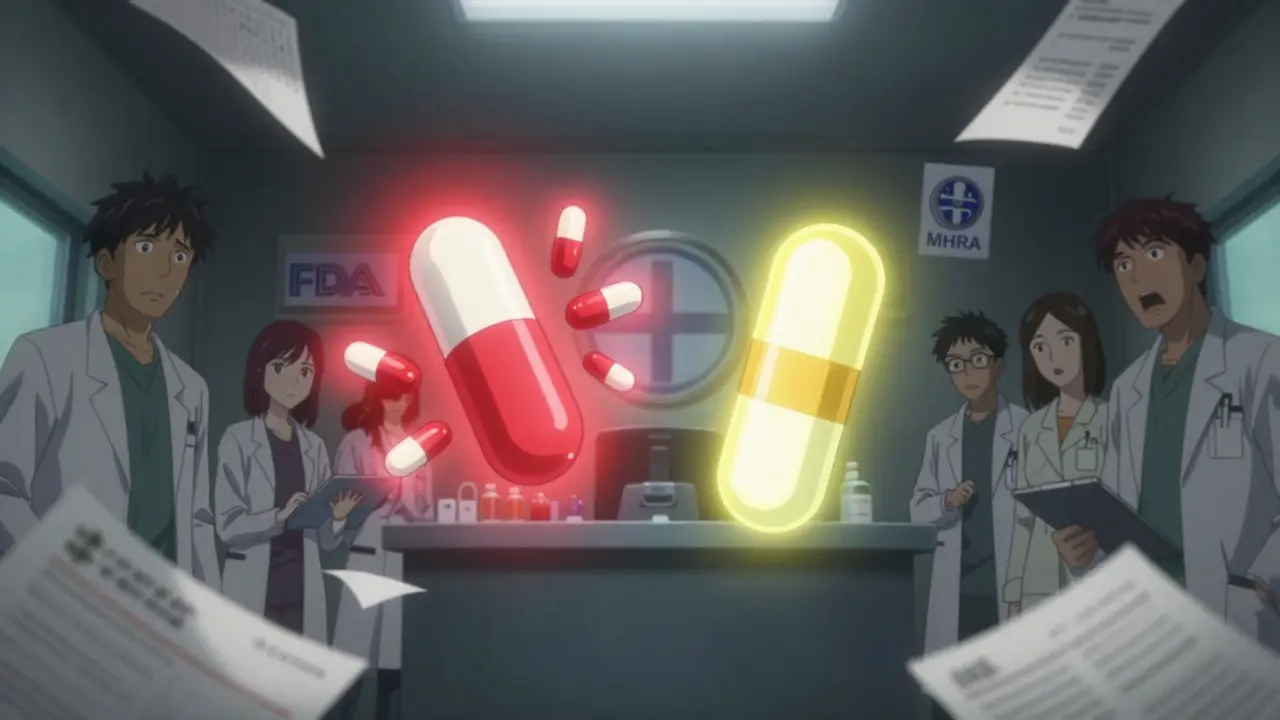
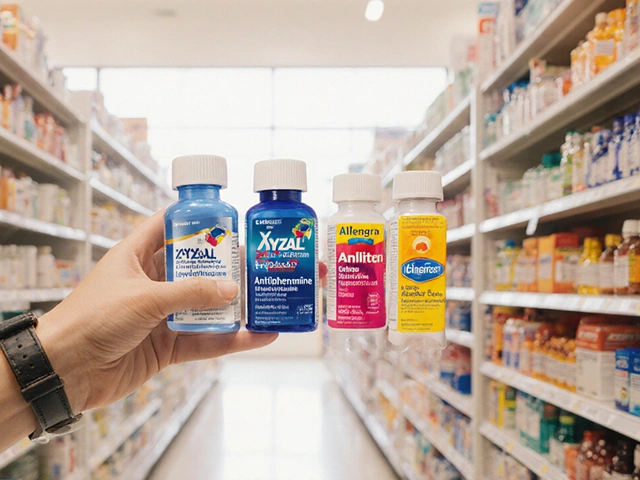
When a drug warning pops up-whether it’s a black box warning, a safety alert, or a letter from your pharmacy-not all alerts are created equal. Some warnings affect every drug in a class. Others target just one. Getting this wrong can mean missing a real risk… or avoiding a safe medication unnecessarily. In the UK and the US, doctors, pharmacists, and patients face this confusion daily. The difference between a class-wide alert and a drug-specific one isn’t just technical-it changes prescribing, spending, and safety.
What’s the Difference Between Class-Wide and Drug-Specific Alerts?
A class-wide safety alert means the risk applies to every drug in that group because of how they work in the body. For example, all ACE inhibitors can cause angioedema (swelling under the skin) because they all block the same enzyme. If one drug in the class shows this side effect, regulators look at whether the whole class shares the risk.
A drug-specific alert targets only one medication. It’s usually because of its unique chemical structure, how it’s metabolized, or rare side effects not shared by others. Take statins: cerivastatin was pulled from the market in 2001 because it caused dangerous muscle damage (rhabdomyolysis) in a small number of patients. But other statins like atorvastatin and simvastatin stayed on shelves because their risks were much lower. The warning wasn’t about the whole class-it was about one drug.
Why does this matter? If you hear a warning about "all beta-blockers," you might stop taking your metoprolol. But if the warning was only for sotalol, you’re unnecessarily stopping a safe, effective drug. Conversely, if you ignore a class-wide alert and keep taking all drugs in that group, you could be putting yourself at risk.
How Regulators Decide: Evidence, Mechanism, and Numbers
The FDA and other agencies don’t guess. They use data. The main tool is the FDA Adverse Event Reporting System (FAERS), which collects over 22 million reports from doctors, patients, and manufacturers. But raw numbers aren’t enough. Regulators need to answer three questions:
- Is the signal strong? A single case report won’t trigger a class warning. You need multiple reports across different databases. The Proportional Reporting Ratio (PRR) must be above 2.0, and the Chi-squared value must exceed 4.0. This means the side effect is happening far more often than expected by chance.
- Is the mechanism shared? Do all drugs in the class work the same way? For example, all fluoroquinolone antibiotics interfere with tendon cells. That’s why, in 2018, the FDA issued a class-wide warning for tendon rupture-not just for ciprofloxacin, but for all drugs ending in "-floxacin."
- Is the evidence consistent? If only one or two drugs in a class show the risk, but the rest don’t-even after testing-it’s likely drug-specific. But if three or more drugs in the class show the same signal, regulators start treating it as class-wide.
Take testosterone products. In 2016, two brands showed blood pressure increases in clinical trials. The FDA didn’t act immediately. It waited until 2023, after testing all 12 marketed testosterone products with ambulatory blood pressure monitoring. Only then did they issue a class-wide warning. That’s the gold standard.
Real-World Confusion: What Happens When Warnings Get Mixed Up?
Healthcare workers don’t always get it right. A 2022 survey of 1,200 U.S. physicians found 68% were unsure whether a warning applied to their whole class or just one drug. Primary care doctors were the most confused-73% said they’d sometimes avoid an entire class after a single warning.
One doctor on Reddit shared how she stopped prescribing all quinolones after the 2018 tendon rupture alert. Later, she realized some patients with complicated UTIs had no other options. She had denied them effective treatment because she assumed the warning covered everything.
Pharmacists are feeling the strain too. Walgreens reported a 22% increase in time spent verifying prescriptions after class-wide alerts, compared to just 8% for drug-specific ones. Why? Because when a class is flagged, pharmacists must check every alternative-instead of just swapping one drug for another.
Even patients get caught. A 2023 report from the Pennsylvania Patient Safety Authority found that 57% of high-alert medication errors involved confusion between two drugs in the same class. Insulin errors alone made up nearly 30% of those cases. People think "all insulins are the same," but long-acting insulin isn’t interchangeable with rapid-acting. One mistake can cause a coma.
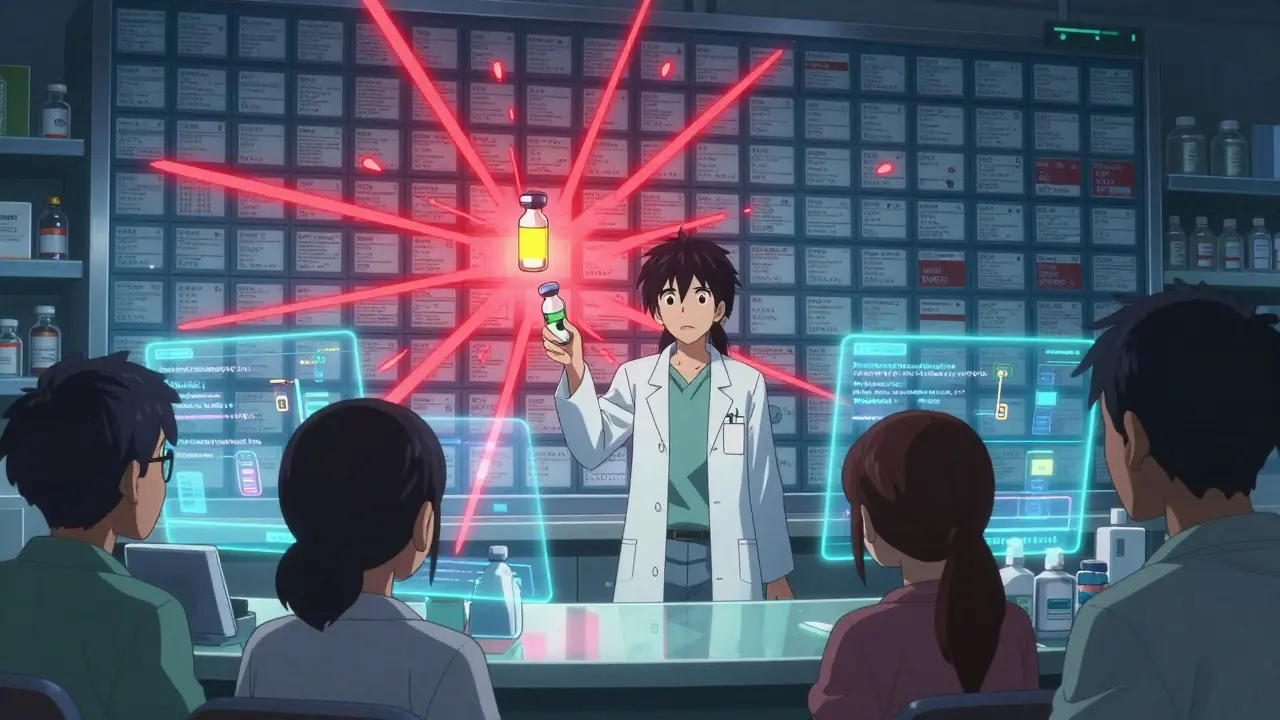
How to Check the Scope of a Warning Yourself
You don’t need to be a regulator to figure this out. Here’s how to do it:
- Look at the official source. Go to the FDA’s Drug Safety Communications page or the UK’s MHRA Yellow Card system. They label alerts clearly: "Class-wide" or "Specific to [Drug Name]."
- Check DailyMed. This free database from the National Library of Medicine color-codes warnings. Red means class-wide. Yellow means drug-specific.
- Read the full label. The package insert (or summary of product characteristics in the UK) lists warnings under "Warnings and Precautions." If it says "all drugs in this class," it’s class-wide. If it names only one drug, it’s specific.
- Don’t assume by name. Just because two drugs have "cef" in the name doesn’t mean they share allergy risks. Only ceftriaxone and cefazolin carry high cross-reactivity with penicillin. Others don’t.
Also, watch out for recall classes. These are different. A Class I recall means the drug could cause serious harm or death. That’s about the product’s safety, not its pharmacological class. A Class I recall on a single antibiotic doesn’t mean the whole class is dangerous.
Why This Matters: Market Impact and Patient Outcomes
Class-wide warnings don’t just change prescribing-they change markets. After the 2018 fluoroquinolone alert, overall use of the class dropped by 17% across the U.S. and UK. But when valdecoxib (Bextra) was pulled in 2004, celecoxib (Celebrex) kept selling. That’s because the warning was drug-specific.
For manufacturers, the difference is huge. A class-wide alert can cut sales for an entire category by 15-25% in two years. A drug-specific alert only hits the one product-often reducing its sales by 40-60%, while the rest of the class survives.
But the real cost is to patients. When warnings are too broad, people lose access to effective drugs. When they’re too narrow, people stay on risky ones. The 2011 FDA analysis found that 33% of therapeutic classes had black box warnings applied to some drugs but not others-even when the risk was similar. That inconsistency breeds mistrust.
What’s Changing Now: AI, Real-World Data, and Better Labels
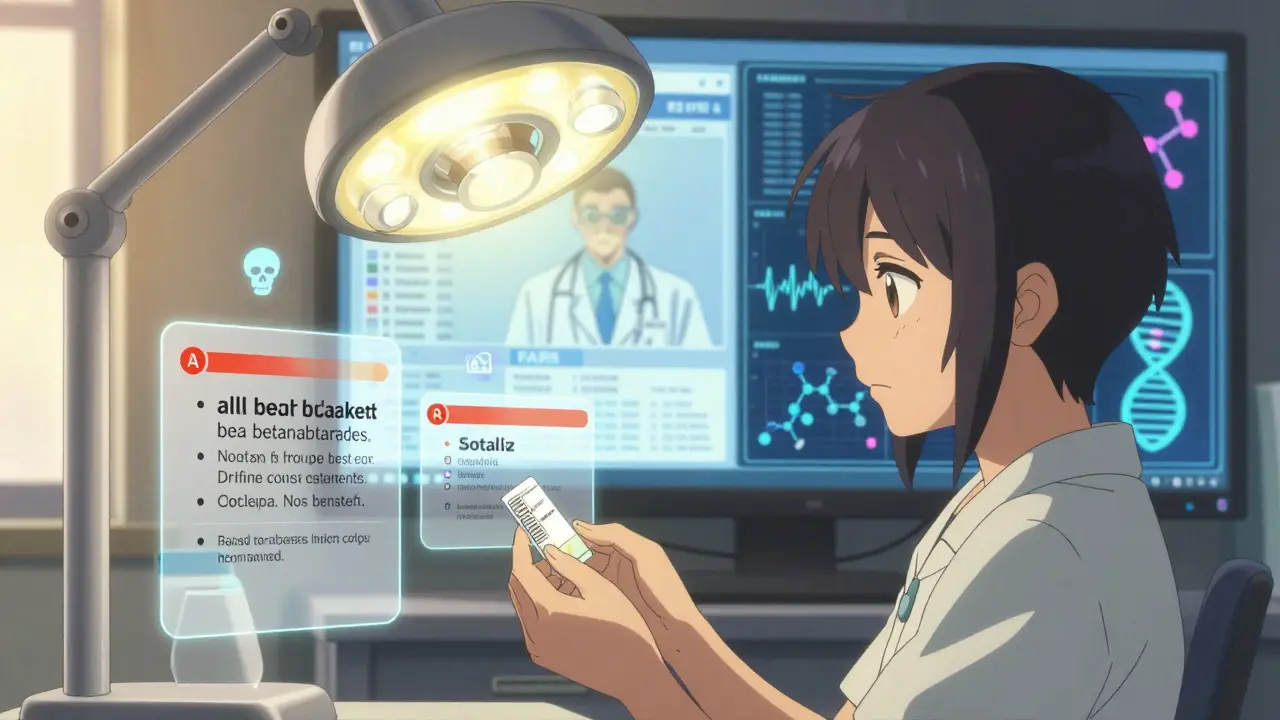
The system is getting smarter. In 2023, the FDA started using AI to predict class risks before they even appear. By analyzing molecular structures and shared metabolic pathways, algorithms can flag drugs likely to share side effects-before hundreds of reports pile up.
In January 2024, the FDA launched a new labeling standard. All new drug labels must now clearly state: "Class Risk: Yes/No" and "Agent-Specific Risk: Yes/No." No more guessing.
And data is getting richer. The National Evaluation System for health Technology (NEST) now pulls data from 100+ healthcare systems covering 100 million patients. That means regulators can see how drugs perform in real life-not just in clinical trials.
But challenges remain. About 72% of drug classes still lack enough post-market data to confidently assign risk scope. That’s why doctors still get confused. That’s why pharmacists still double-check. And that’s why you should always ask: "Is this warning for the whole class-or just this one?""
What to Do Next
When you see a safety alert:
- Find the official source: FDA.gov, MHRA.gov, or DailyMed.
- Check if it says "all drugs in this class" or names just one.
- Don’t assume similarity by name-check the active ingredient.
- Ask your pharmacist: "Is this a class-wide alert?" They’re trained to know.
- Never stop a medication without talking to your doctor.
Class-wide and drug-specific alerts aren’t just regulatory details. They’re tools for safety. Use them right, and you avoid harm. Use them wrong, and you risk more than just side effects-you risk losing access to medicine you need.





Comments (14)
Joe Grushkin
February 14, 2026 AT 22:09 PMClass-wide alerts are just regulatory theater. They don't reflect pharmacology-they reflect liability avoidance. The FDA doesn't care if you lose access to a life-saving drug because they got lazy with their risk assessment. They'd rather blanket the whole class than do the hard work of differential analysis. This isn't science. It's PR.
Virginia Kimball
February 16, 2026 AT 14:18 PMLove this breakdown! Honestly, I’ve been so frustrated with how scary these alerts sound without context. I’m a nurse and I’ve seen patients panic over a single headline. This is the kind of clarity we need to stop the fear-mongering. Thank you for making it real.
Chiruvella Pardha Krishna
February 16, 2026 AT 20:40 PMWhen we reduce medicine to binary classifications-class or individual-we ignore the subtle symphonies of human biochemistry. A drug is not a label. It is a conversation between molecule and membrane, between enzyme and expectation. The regulatory mind seeks order. But life is noise.
Sarah Barrett
February 18, 2026 AT 09:56 AMWhile the distinction between class-wide and drug-specific alerts is critical, I’m concerned about the lack of standardized terminology across international regulators. The MHRA and FDA sometimes use conflicting language, which only deepens confusion for global prescribers and patients alike. Harmonization is overdue.
Kaye Alcaraz
February 19, 2026 AT 21:27 PMThis is exactly the kind of practical, evidence-based guidance we need in clinical practice. So many of us are just trying to do right by our patients-and this helps us cut through the noise. Thank you for writing this. Please keep sharing insights like this.
Charlotte Dacre
February 21, 2026 AT 03:28 AMOh great, so now we’re going to have a whole new category of drug names with ‘Class Risk: Yes/No’ stamped on them like a grocery item. Next they’ll put a QR code on fentanyl patches that says ‘WARNING: May kill you. Also, this one’s not class-wide.’
Esha Pathak
February 23, 2026 AT 02:19 AMEvery time I read something like this, I think of the Bhagavad Gita: ‘You are not the drug. You are not the warning. You are the awareness between them.’ The truth is, no algorithm can replace the quiet intuition of a clinician who’s seen 300 patients on metoprolol and none with angioedema. We are not data points. We are humans with hands.
Mike Hammer
February 23, 2026 AT 15:05 PMmy man just said all beta blockers cause angioedema? lol no. i thought that was just sotalol and maybe carvedilol? i had a patient on metoprolol for 12 years and never had a problem. also, i think the FDA is just scared of lawsuits so they just slap class-wide on everything now. kinda dumb tbh.
Daniel Dover
February 24, 2026 AT 15:49 PMSimple. If the mechanism is shared, it’s class-wide. If the metabolism or structure is unique, it’s specific. No need for 22 million reports. Just look at the chemistry.
Kapil Verma
February 25, 2026 AT 22:01 PMIn India, we don’t have this luxury. We use generic drugs because we can’t afford branded ones. When a class-wide alert hits, it wipes out entire treatment options for millions. The West gets precision. We get panic. Your ‘gold standard’ is our death sentence.
Mandeep Singh
February 27, 2026 AT 11:33 AMLet me tell you something. The entire pharmaceutical industry is built on obfuscation. They design drugs to exploit loopholes in pharmacological classification. They know that if they tweak a methyl group just enough, they can escape a class-wide warning. This isn’t about safety-it’s about patents, profits, and regulatory arbitrage. The FDA is a puppet. The real regulators are the shareholders.
Josiah Demara
March 1, 2026 AT 10:03 AMLet’s not pretend this is about patient safety. The 2018 fluoroquinolone alert caused a 17% drop in usage? That’s not a safety win-that’s a market collapse. Meanwhile, the real culprit-the overprescription of antibiotics-is ignored. This whole system is a distraction. They’re not protecting you. They’re protecting the revenue streams of the companies that fund their studies. You’re being played.
Erica Banatao Darilag
March 3, 2026 AT 07:04 AMi just wanted to say thank you for this. i misread a warning once and stopped my dad’s simvastatin because i thought it was class-wide. he had a heart attack two weeks later. i didn’t know how to check. this article saved me from repeating that mistake. i’m so grateful.
Michael Page
March 4, 2026 AT 19:25 PMThere’s a deeper question here: Why do we trust regulatory agencies to define safety at all? What if the risk isn’t in the drug-but in the system that prescribes it? The real alert isn’t on the label. It’s in the silence between the lines.