

The U.S. generic drug market didn’t just grow-it exploded. Today, 90% of all prescriptions filled in America are for generic drugs, costing 80-85% less than brand-name versions. But that wasn’t always the case. Before 1984, getting a generic drug approved was nearly impossible. The law that changed everything? The Hatch-Waxman Amendments.
What Was the Problem Before Hatch-Waxman?
Before the Drug Price Competition and Patent Term Restoration Act of 1984, generic drug makers had to prove their products were safe and effective from scratch. That meant running full clinical trials, even though the drug’s chemistry was identical to the brand-name version. It wasn’t just expensive-it was pointless. The FDA had already approved the original drug. Repeating the same tests was a waste of time, money, and resources.On top of that, patent law worked against generics. A 1984 court case, Roche Products v. Bolar Pharmaceutical, ruled that generic companies couldn’t even start testing a drug until the patent expired. That meant a generic drug couldn’t hit the market until years after the patent ended. Patients paid higher prices longer. Manufacturers lost out on market opportunities. And innovation? It was stuck.
The Two Goals of Hatch-Waxman
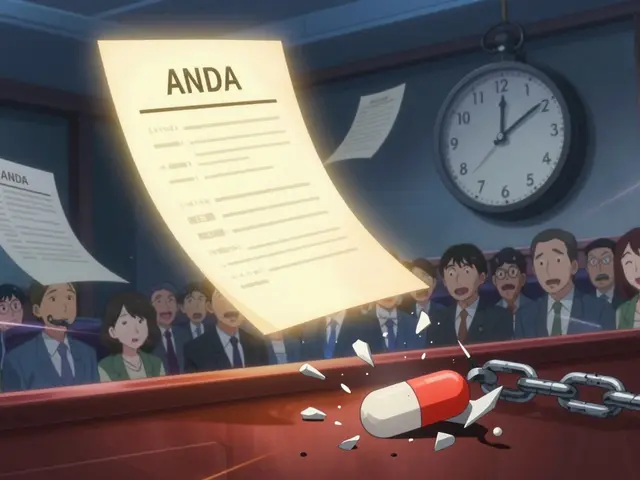
The Hatch-Waxman Act wasn’t designed to help one side win. It was built to balance two competing interests. On one hand, brand-name drug companies needed time to recoup their R&D investments. On the other, patients and taxpayers needed affordable medicines. The solution? Two big changes.First, it created the Abbreviated New Drug Application (ANDA). This let generic manufacturers skip clinical trials. All they had to prove was that their version was bioequivalent-meaning it worked the same way in the body as the brand-name drug. That cut development costs by 80-90%. Suddenly, making generics wasn’t a moonshot. It was a viable business.
Second, it gave brand-name companies a way to get back some of the time they lost waiting for FDA approval. Patents typically last 20 years, but by the time a drug clears clinical trials and gets approved, half that time might be gone. Hatch-Waxman allowed patent term restoration of up to five years, plus up to three additional years for new uses or formulations. That kept the incentive to innovate alive.
The Orange Book and Patent Challenges
To make this system work, the law created a public list: the Orange Book. Brand-name companies had to list every patent tied to their drug. Generic makers then had to check that list and file one of four certifications when applying for approval.The most important one? Paragraph IV certification. This is where a generic company says, “Your patent is invalid, or we don’t infringe it.” It’s a legal challenge wrapped in an application. And here’s the kicker: the first company to file a Paragraph IV certification gets 180 days of exclusive market access. No other generic can enter during that time. That’s a huge financial reward-often worth hundreds of millions of dollars.
This created a race. Generic companies started filing Paragraph IV certifications the moment a patent expired or was about to be challenged. Some even filed on the same day, leading the FDA to later rule that if multiple companies filed on the same day, they’d share the 180-day window. It turned patent law into a high-stakes game of timing and strategy.
The Safe Harbor: Why Generics Can Start Early
One of the most overlooked parts of Hatch-Waxman is the safe harbor provision under 35 U.S.C. § 271(e)(1). It says: if you’re doing research to get FDA approval, you’re not infringing a patent-even if the patent hasn’t expired yet.This was revolutionary. Before this, even testing a generic version before patent expiration was illegal. Now, generic companies could begin developing their product years in advance. They could run bioequivalence studies, tweak formulations, and prepare manufacturing lines-all while the brand-name drug was still under patent. That’s why today, dozens of generic versions are often ready to launch the moment a patent expires.
The Impact: Prices, Access, and Innovation
The results speak for themselves. In 1983, generics made up less than 19% of U.S. prescriptions. By 2023, that number hit 90%. The FDA reports over 10,000 generic drugs are now available. Patients save an estimated $300 billion a year because of them.But it’s not all smooth sailing. Critics argue the system has been gamed. Brand-name companies now use tactics like “evergreening”-making small changes to a drug (like switching from a pill to a liquid) to get new patents. They file citizen petitions to delay FDA approvals. And worst of all, they pay generic companies to stay off the market.
These “pay-for-delay” deals are illegal under antitrust law, but they happened anyway. The Federal Trade Commission found 668 such agreements between 1999 and 2012, costing consumers $35 billion a year. The FTC and Congress have tried to crack down, but loopholes remain.
How the System Has Evolved Since 1984
Hatch-Waxman wasn’t meant to be permanent. It was a framework-and like any framework, it needed updates.In 1997, the FDA Modernization Act streamlined the review process. In 2003, the Medicare Prescription Drug Act added rules around orphan drugs and pediatric exclusivity. In 2012, the Generic Drug User Fee Amendments (GDUFA) gave the FDA money to hire more reviewers. Before GDUFA, it took an average of 30 months to approve an ANDA. By 2022, that dropped to under 12 months.
Today, the FDA is pushing even harder. They’ve launched initiatives to tackle shortages, improve quality control, and speed up approvals for complex generics like inhalers and injectables. The goal? Make sure the Hatch-Waxman system still works in an era of biologics, biosimilars, and rising drug costs.
Is the Balance Still Right?
The original compromise was simple: let generics in fast, but give innovators enough time to profit. But the world has changed. R&D costs have skyrocketed. Patent terms are longer. And drug prices? They’ve become a national crisis.Some say Hatch-Waxman needs a major overhaul. Others argue it’s still the best system we have. The truth? It’s both. The law created the modern generic industry. It saved billions. It gave patients access to life-saving drugs they couldn’t otherwise afford.
But it also created incentives for abuse. The 180-day exclusivity window? Sometimes it’s used to block competition, not encourage it. The patent linkage system? It’s become a tool for litigation, not transparency.
Legislation like the 2023 Preserve Access to Affordable Generics and Biosimilars Act aims to close those loopholes. But until Congress acts, the system remains a mix of brilliance and vulnerability.
Why It Matters Today
If you’ve ever picked up a generic pill at the pharmacy and wondered why it cost $4 instead of $400, thank Hatch-Waxman. It didn’t just change the rules-it changed lives.It’s not perfect. But without it, millions of Americans would still be paying brand-name prices for drugs that have been around for decades. The law didn’t end high drug costs-but it gave us the most powerful tool we have to fight them: competition.
What is the Hatch-Waxman Act?
The Hatch-Waxman Act, officially the Drug Price Competition and Patent Term Restoration Act of 1984, is U.S. federal law that created the modern system for approving generic drugs. It lets generic manufacturers prove their drugs are bioequivalent to brand-name drugs without repeating clinical trials, while also giving brand-name companies extra patent time to make up for delays in FDA approval.
How did Hatch-Waxman change generic drug approval?
Before Hatch-Waxman, generic companies had to run full clinical trials to prove safety and effectiveness. The law introduced the Abbreviated New Drug Application (ANDA), which allows generics to rely on the FDA’s prior approval of the brand-name drug. They only need to show bioequivalence-meaning the drug works the same way in the body-cutting development time and cost by up to 90%.
What is Paragraph IV certification?
Paragraph IV certification is a legal challenge filed by a generic drug company that says a brand-name drug’s patent is invalid or that their product doesn’t infringe it. The first company to file a Paragraph IV certification gets 180 days of exclusive market rights, creating a powerful incentive to challenge weak or overbroad patents.
What is the Orange Book?
The Orange Book is the FDA’s official list of approved drug products with their patent and exclusivity information. Brand-name companies must list all patents related to their drugs here. Generic manufacturers use this list to determine which patents they must address when filing an ANDA.
Why do some people say Hatch-Waxman caused high drug prices?
Critics argue that while Hatch-Waxman helped generics, it also gave brand-name companies tools to delay competition. Tactics like “evergreening,” filing frivolous citizen petitions, and paying generic companies to delay launch (pay-for-delay) have kept prices high. These practices exploit the system’s loopholes, turning competition into a legal battle instead of a market race.
Does Hatch-Waxman still work today?
Yes, but it’s under pressure. The system still delivers 90% generic market share and saves billions annually. However, the rise of complex drugs, biosimilars, and patent abuse means the original 1984 framework needs updates. Recent FDA reforms like GDUFA have improved review times, but Congress still needs to address pay-for-delay and evergreening to keep the balance fair.
What Comes Next?
The next big challenge isn’t just about pills and patents-it’s about how we pay for them. As more biologics and biosimilars enter the market, the FDA and Congress will need to adapt Hatch-Waxman’s principles to new kinds of drugs. Will the same rules that worked for aspirin and statins work for gene therapies? Maybe not. But the core idea-that competition lowers prices and expands access-still holds.For now, the Hatch-Waxman Act remains the backbone of America’s drug supply. It’s not glamorous. It’s not perfect. But it’s the reason your prescription costs less than it used to-and that’s worth remembering.


Comments (15)
Jessica Salgado
December 17, 2025 AT 10:56 AMThis law is literally why my insulin costs $30 instead of $300. I didn’t even know what Hatch-Waxman was until last week, but now I’m telling everyone I know. If you’ve ever been told ‘it’s just a generic’ like it’s second-rate - it’s not. It’s justice in a pill bottle.
Thank you for explaining this so clearly. I’m not a policy person, but this? This I get.
Steven Lavoie
December 17, 2025 AT 15:32 PMThe Hatch-Waxman Act represents one of the most elegant policy compromises in modern American history: incentivizing innovation while ensuring access. The creation of the ANDA pathway, coupled with the safe harbor provision, resolved a fundamental tension between intellectual property rights and public health.
It’s worth noting that the 180-day exclusivity period, while intended to spur generic entry, has often been weaponized - particularly through ‘reverse payment’ settlements. The FTC has repeatedly flagged this as anticompetitive behavior, yet enforcement remains inconsistent.
What’s remarkable is how this 1984 framework still holds up under the weight of biologics and biosimilars - albeit with strain. The real test now is whether Congress can update it without breaking what still works.
Anu radha
December 18, 2025 AT 00:28 AMI am from India. Here generic drugs are cheap, but not always good. I saw my cousin get sick because of bad generic medicine. So I am happy America made this law - but also scared it can go wrong too.
Hope FDA is watching.
Jigar shah
December 18, 2025 AT 15:58 PMParagraph IV certifications are the unsung heroes of the generic industry. The legal risk is enormous - you’re basically challenging a pharma giant’s patent and inviting a lawsuit. But the payoff? 180 days of monopoly pricing on a blockbuster drug.
It’s not just about access - it’s about economic mobility for small generic manufacturers. Without this, Big Pharma would own the market forever. The system’s flawed, yes - but it’s the only thing keeping prices from spiraling into the stratosphere.
Sachin Bhorde
December 19, 2025 AT 00:42 AMyo so like Hatch-Waxman? total game changer. ANDA? yes. Orange Book? lit. Paragraph IV? that’s where the real drama happens.
bro i saw a startup get funded just because they filed a para iv on a $2B drug. 180 days = $500M. no cap.
but also… evergreening? pay-for-delay? bro that’s just pharma being pharma. FDA’s trying, but they’re understaffed. GDUFA helped but still not enough. we need more reviewers and less lawyers.
Joe Bartlett
December 19, 2025 AT 01:17 AMY’know, this is why America still leads. Other countries just copy drugs. We built a system that rewards innovation AND competition. Simple. Elegant. Works.
Europe? They just cap prices and kill R&D. China? They steal patents. We? We fix it. That’s why we’re still #1.
Marie Mee
December 19, 2025 AT 02:51 AMthey don’t want you to know this but the FDA and Big Pharma are in cahoots
the orange book is fake
paragraph iv is rigged
they let the same 3 companies get the 180 day window every time
and the pay for delay deals? they’re legal because the congress is bought
your insulin is expensive because they want you sick
they’re not trying to help
they’re trying to control
and you’re just a number in their spreadsheet
wake up
they’re lying to you
every single time
Salome Perez
December 20, 2025 AT 01:31 AMThe elegance of Hatch-Waxman lies not in its perfection, but in its humility. It acknowledged that innovation and access are not adversaries - they are partners in the sacred contract between science and society.
By granting patent term restoration, it honored the courage of the researchers who spent a decade in the lab. By enabling bioequivalence through ANDA, it honored the dignity of the patient who cannot choose between medicine and rent.
Today, as we stand at the precipice of gene therapies and AI-driven drug discovery, we must not discard this framework - we must elevate it. The soul of American pharmaceutical policy is not in the patent office, but in the pharmacy aisle.
Let us not forget: a pill is not a product. It is a promise.
Kent Peterson
December 21, 2025 AT 21:43 PMUgh. Another ‘Hatch-Waxman is brilliant’ piece. Let’s be real - this law created a monopoly machine disguised as competition.
180-day exclusivity? That’s not competition - it’s a cartel handshake.
Paragraph IV? More like Paragraph I’m-rich-now.
And don’t even get me started on the ‘safe harbor’ - it’s a loophole that lets generics build factories while the brand-name drug is still under patent. That’s not innovation - that’s legalized piracy.
And now we’re supposed to celebrate this as a ‘win’? No. It’s a rigged game. The only winners are lawyers and CEOs.
And you? You’re still paying $200 for insulin.
Wake up. This isn’t a system. It’s a scam with footnotes.
Josh Potter
December 23, 2025 AT 05:19 AMbro this is wild. i just found out my blood pressure med is generic because of this 1984 law and now i’m crying
we need to make a meme about this
‘me: i thought generics were cheap because they’re bad
also me: turns out the system was designed to save my life’
hatch-waxman is the real MVP
whoever wrote this post? you just saved my bank account
send help. or at least send more posts like this
Evelyn Vélez Mejía
December 25, 2025 AT 03:17 AMThe moral architecture of Hatch-Waxman is rooted in a classical liberal conception of justice: the state must not interfere with the legitimate returns of innovation, yet it must not permit monopolistic exploitation of essential goods.
By structuring the ANDA pathway, the law created a procedural bridge between private capital and public welfare - a rare instance where market logic and ethical obligation converged.
Yet, as the system has matured, the equilibrium has eroded. The 180-day exclusivity window, originally designed to incentivize challenge, has become a tool of strategic delay. The Orange Book, intended as a transparent ledger, has been weaponized into a labyrinth of litigation.
The true test of a civilization is not how it rewards creation, but how it protects access. Hatch-Waxman was a noble experiment. Now, it demands a moral reckoning.
Victoria Rogers
December 27, 2025 AT 00:58 AMgeneric drugs are just as dangerous as the brand ones
they use the same stuff but the fillers are different
my friend had a seizure after switching
the FDA doesn't test the fillers
and the orange book is a lie
they list patents that dont even exist
and the 180 day thing? its just so big pharma can buy the first generic and shut it down
you think this law helped? no
it just made the scam look legal
youre being played
every single time you take a generic you're gambling
and the government is the dealer
Linda Caldwell
December 27, 2025 AT 07:29 AMI didn’t know any of this but now I’m telling my whole family. My grandma’s cholesterol med is $4. She used to skip doses because it was $400. This law saved her life. I’m so grateful.
Let’s not overcomplicate it. It works. It saves lives. Let’s fix the parts that are broken - but don’t throw out the whole thing.
Patrick A. Ck. Trip
December 28, 2025 AT 17:52 PMIt is worth reflecting that the Hatch-Waxman Act, while imperfect, represents a rare moment in legislative history where stakeholders - pharmaceutical innovators, generic manufacturers, patient advocacy groups, and regulatory bodies - arrived at a functional equilibrium.
Its longevity, spanning nearly four decades, speaks to the soundness of its foundational principles: bioequivalence as sufficient proof of therapeutic equivalence; patent term restoration as a counterbalance to regulatory delay; and the safe harbor as an enabling mechanism for timely market entry.
Modern challenges - biosimilars, complex generics, and global supply chain fragility - do not invalidate the framework; they demand its refinement. To abandon it would be to discard the most effective public health tool for drug affordability in American history.
Let us not confuse the corruption of incentives with the failure of design.
Jessica Salgado
December 29, 2025 AT 10:01 AMActually, I just read something that made me rethink this. The 180-day exclusivity isn’t always used to lower prices - sometimes the first filer just sits on it and waits for the brand to lower their price first. Then they jump in. So the real winner isn’t the patient - it’s the generic company that plays the waiting game.
That’s why prices don’t always drop right away. It’s not just patents being abused - it’s market manipulation.
Thanks for the post. It made me dig deeper.