

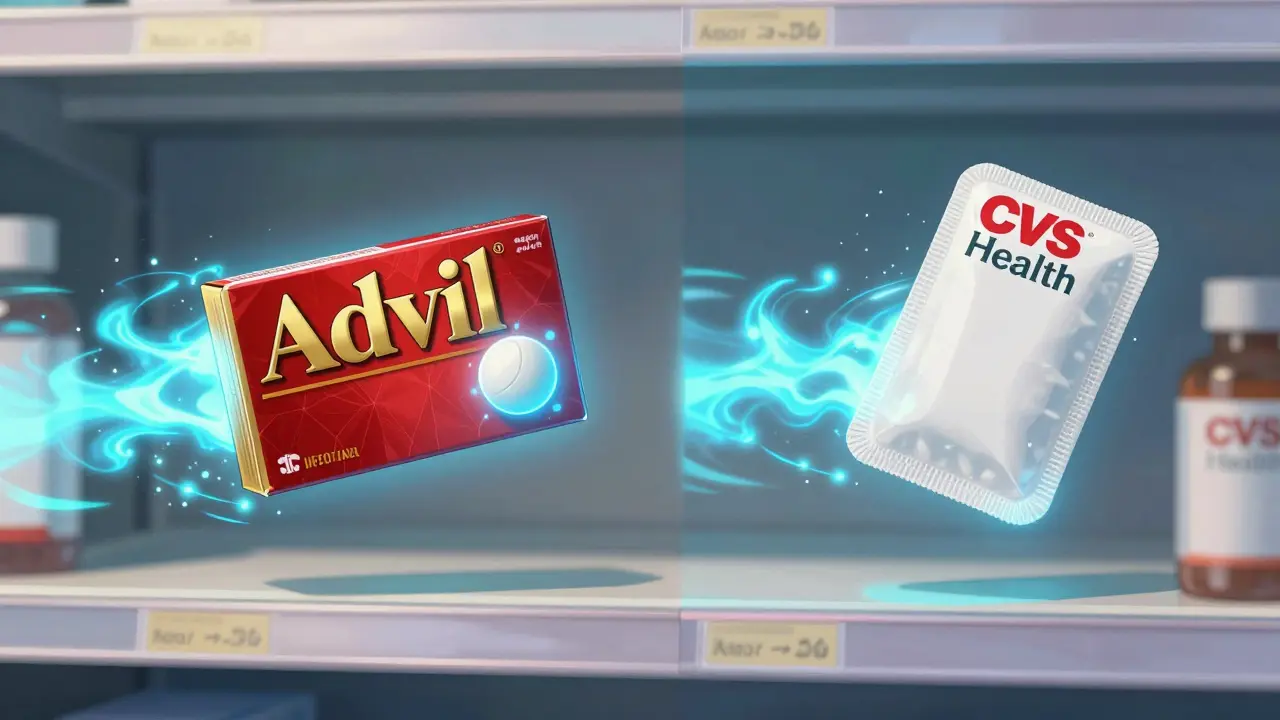
How much are you spending on over-the-counter (OTC) medications every month? If you’re still reaching for the name-brand box because you think it works better, you might be throwing away hundreds of pounds a year. The truth? In most cases, the store brand you pick up at the supermarket or pharmacy is exactly the same as the expensive name brand-just cheaper.
What Makes Store Brands Different?
Store brands, also called generics or private label drugs, are made by the same manufacturers who produce name brands. Think of it like this: the same factory that makes Advil also makes the ibuprofen sold under CVS Health, Walmart’s Equate, or Target’s Up & Up. The only difference? The label.
The active ingredient-the part that actually treats your headache, fever, or allergy-is identical. If you look at the Drug Facts label on any OTC product, the first thing listed is the active ingredient. For example:
- Advil = ibuprofen
- CVS Health Pain Relief = ibuprofen
- Walgreens Ibuprofen = ibuprofen
Same molecule. Same dose. Same effect. The FDA requires store brands to prove they deliver the same amount of medicine into your bloodstream at the same speed as the brand name. That’s called bioequivalence. And it’s not a suggestion-it’s the law.
Why Are Store Brands So Much Cheaper?
Brand names spend millions on advertising, fancy packaging, and celebrity endorsements. Store brands skip all that. No TV commercials. No shiny boxes with logos. Just plain labeling and lower overhead. That’s where the savings come from.
According to IQVIA’s 2023 report, store brands make up 67% of all OTC medications sold by volume. But because name brands cost more, they still take in more money. That means you’re paying extra just for the name.
Here’s what the price difference looks like in real terms:
| Medication | Name Brand (30 tablets) | Store Brand (30 tablets) | Savings |
|---|---|---|---|
| Acetaminophen (Tylenol) | £7.99 | £1.49 | 81% |
| Ibuprofen (Advil) | £8.50 | £1.29 | 85% |
| Loratadine (Claritin) | £12.00 | £3.99 | 67% |
| Dextromethorphan (Robitussin) | £9.75 | £2.50 | 74% |
That’s not a typo. You’re saving £6-£8 on a bottle that does the exact same thing. If you take pain relievers twice a week, that’s over £300 saved a year.
Are Store Brands Just as Safe and Effective?
Yes. The FDA doesn’t cut corners with generics. Every store brand OTC medication must meet the same strict standards as the name brand. The same inspections. The same quality controls. The same testing.
The FDA inspects around 3,500 manufacturing facilities every year-and about half of them make generic drugs. That’s not luck. That’s policy. And it’s backed by science.
A 2021 study from the National Center for Biotechnology Information found that generic and brand-name drugs differ in absorption by only 3.5% on average. The FDA allows up to 20% variation and still considers them equivalent. So even at the upper limit, you’re getting the same medicine.
Pharmacists know this better than anyone. A 2023 Pharmacy Times survey showed 92% of pharmacists confidently recommend store brands to patients. And 89% of them use store brands for their own families.

When Might You Still Need the Name Brand?
Most people won’t notice a difference. But some might.
The difference isn’t in the active ingredient. It’s in the fillers. The dyes. The flavors. The coatings. These are called inactive ingredients. They don’t treat your symptoms. But they can affect how the pill feels in your mouth, how quickly it dissolves, or if you’re allergic to something like cornstarch, food dye, or lactose.
If you’ve ever had a rash after taking a store-brand allergy pill-or if your stomach feels off after a generic antacid-it’s likely one of these fillers. Not the medicine itself.
That’s why some people stick with name brands. Not because they work better. But because they know how their body reacts to the specific inactive ingredients in that product.
Dr. Eric D’Agostino, a pharmacist at Brown University, says: “If your health doesn’t improve or you have side effects or reactions to a generic, you may need the brand-name drug.”
It’s rare-but it happens. And if it happens to you, you can always switch back. But don’t assume you need the name brand just because it’s more expensive.
How to Choose the Right Store Brand
It’s simple. Look at the Drug Facts label. Here’s what to check:
- Active ingredient - Must match exactly (e.g., ibuprofen 200mg).
- Dosage - Same number of milligrams per tablet or capsule.
- Form - Tablet, liquid, or caplet? Match it.
- Directions - Should be identical: how often, how much, warnings.
If those four things match, you’re getting the same medicine. The rest? Marketing.
Pro tip: If you’re using multiple OTC products (like a cold medicine and a pain reliever), check for duplicate active ingredients. A 2023 FDA alert found that 23% of people accidentally take too much acetaminophen by mixing products. Store brands don’t cause this-confusion does.
What’s Changing in 2026?
Store brands are getting smarter. CVS now puts QR codes on their packaging that link to full ingredient lists. Walgreens launched a free pharmacist chat service just for store-brand questions. Walmart’s Equate line now has over 1,200 OTC products-from cough syrup to hemorrhoid cream.
And the trend is only going up. Grand View Research predicts store brands will make up 72% of all OTC sales by 2028. Retailers are spending billions to improve formulations, packaging, and transparency.
Meanwhile, the FDA is making it faster and easier to approve generic versions of complex OTC drugs. That means even more choices-and even lower prices-coming soon.
What Do Real Users Say?
On Reddit’s r/pharmacy thread from September 2023, 247 people shared their experiences with store brands. 89% said they couldn’t tell any difference between CVS ibuprofen and Advil. Amazon reviews from January 2024 showed store brands averaging 4.3 stars-just 0.1 lower than name brands.
One Walmart customer wrote: “I’ve used CVS brand ibuprofen for 5 years and couldn’t tell any difference from Advil.”
Only 12% of 1-star reviews for both store and name brands said “no effect.” That’s not a failure of generics. That’s the reality of medicine-sometimes nothing works. And that’s true no matter the label.
Final Thought: You’re Not Losing Quality-You’re Gaining Savings
There’s a myth out there that name brands are better. But the data doesn’t back it up. The FDA, pharmacists, doctors, and millions of users agree: store brands work just as well.
The only real difference? The price tag. And your wallet.
Next time you need pain relief, allergy help, or stomach relief, grab the store brand. Read the label. Confirm the active ingredient. And save the cash for something that matters more-like a weekend away, a new book, or just putting a little more in your savings account.
Are store brand OTC medications as safe as name brands?
Yes. Both store brands and name brands must meet the same FDA standards for safety, strength, quality, and performance. The FDA requires store brands to prove they deliver the same active ingredient in the same amount and at the same rate as the brand name. Manufacturing facilities for both are inspected equally, with around 3,500 inspections conducted annually.
Why do store brands cost so much less?
Store brands save money by skipping advertising, fancy packaging, and brand marketing. The same factories that make Advil or Tylenol often make the store versions. The active ingredient is identical, but without the marketing costs, the price drops by 80-85%. You’re paying for the medicine, not the logo.
Can store brands cause side effects that name brands don’t?
Not from the active ingredient. But store brands may use different inactive ingredients-like dyes, fillers, or flavors-which can cause rare allergic reactions or stomach upset in sensitive people. If you have a reaction, switching back to the name brand often helps. But this affects less than 1% of users.
How do I know if a store brand is the right one?
Look at the Drug Facts label. The first line should list the active ingredient-make sure it matches the name brand exactly. Then check the dosage (e.g., 200mg), form (tablet, liquid), and directions. If those match, it’s equivalent. Ignore the color, shape, or brand name on the front.
Do pharmacists recommend store brands?
Yes. A 2023 survey found that 92% of pharmacists confidently recommend store brands to patients. And 89% of them use store brands for themselves and their families. Pharmacists know the science-and they’re not pushing you to spend more.





Comments (13)
Brad Ralph
February 14, 2026 AT 02:35 AMlol at people who still pay extra for the blue pill with the fancy logo. 🤡 same chem, same factory, same FDA stamp. You’re not a VIP, you’re just funding ad campaigns.
Vamsi Krishna
February 15, 2026 AT 03:28 AMI work in pharma logistics in Mumbai and I’ve seen the same生产线 churn out Advil and CVS ibuprofen side by side. Same batch number prefix, same QC logs. The only thing different? The sticker. People pay £8 for branding like it’s a Rolex. Bro, it’s a painkiller. 🤦♂️
Ernie Simsek
February 15, 2026 AT 04:33 AMI used to be a name-brand guy until I tried Equate for migraines. Felt the same. Saved $60 a year. Now I laugh at people who say 'but what if it doesn't work?' Like... it’s not magic, it’s ibuprofen. 💊😂
Carla McKinney
February 16, 2026 AT 07:08 AMI’ve read the FDA guidelines. I’ve checked the manufacturing plants. I’ve reviewed the bioequivalence studies. And yet… I still won’t touch store brands. Why? Because I don’t trust systems. Someone’s always cutting corners. Maybe not today. But tomorrow? You’ll see.
Alyssa Williams
February 16, 2026 AT 09:27 AMI switched to store brand allergy pills last year and my nose stopped acting like a leaky faucet. Also saved enough to buy a new pair of sneakers. Win win. Stop overthinking it and just try it. 🙌
Rob Turner
February 16, 2026 AT 10:19 AMIn the UK, we’ve been doing this for decades. Boots and Sainsbury’s generics are everywhere. My mum’s been on them since the 90s. She says the only difference is the price. And the fact she doesn’t have to feel guilty about spending £12 on a bottle of pills. 🇬🇧
Ojus Save
February 16, 2026 AT 11:17 AMi tried store brand and it worked fine. but then i read somewhere that fillers can be different. so now i only use the ones with no dyes. idk if that’s real or not. maybe someone can tell me?
Annie Joyce
February 16, 2026 AT 20:19 PMThe fillers thing? Totally real. My cousin has a corn allergy and went into anaphylaxis after a generic cold med. Turned out the coating had cornstarch. Name brand used rice starch. He switched back and boom - no more ER visits. So yeah, sometimes it matters. Not because the medicine’s better. But because your body’s weird. 🤷♀️
Robert Petersen
February 17, 2026 AT 16:26 PMThis is such a great breakdown. Seriously, if you’re still buying name brands out of habit, you’re not being loyal - you’re being exploited. The science is clear. The savings are insane. And pharmacists? They’re the ones telling you to switch. Trust the experts, not the ads. You’ve got this! 💪
Luke Trouten
February 19, 2026 AT 10:49 AMIt’s fascinating how much of our behavior is shaped by branding. We treat pills like luxury goods - when they’re literally just molecules in a capsule. The psychological weight we give to a logo is absurd. We’d never pay 85% more for identical rice. Why do we do it with medicine? Maybe we’re not as rational as we think.
alex clo
February 21, 2026 AT 04:45 AMThe FDA’s bioequivalence standard is 80-125% plasma concentration overlap. That’s a 45% window. Most generics fall within 3-5%. But the fact that this is even a debate shows how poorly the public understands pharmacology. Education over marketing. Always.
Autumn Frankart
February 23, 2026 AT 00:36 AMI heard Walmart’s Equate line is actually made by Pfizer. And CVS? Owned by a private equity firm that cuts corners on quality control. The label says 'same active ingredient' - but what about the manufacturing environment? Are they using the same sterile lines? The same water purification? Or are they skimping on the little things? I don’t trust it. Not one bit.
Joanne Tan
February 24, 2026 AT 17:56 PMI’ve been using store brand for 7 years. No issues. My mom? She’s 72. Swears by Advil. Says she ‘feels’ the difference. I asked her why. She said ‘it just feels smoother’. We tested her blind - same bottle, different labels. She picked the name brand. Turns out, placebo works. And honestly? If it helps her feel better, who am I to argue? 🤗