

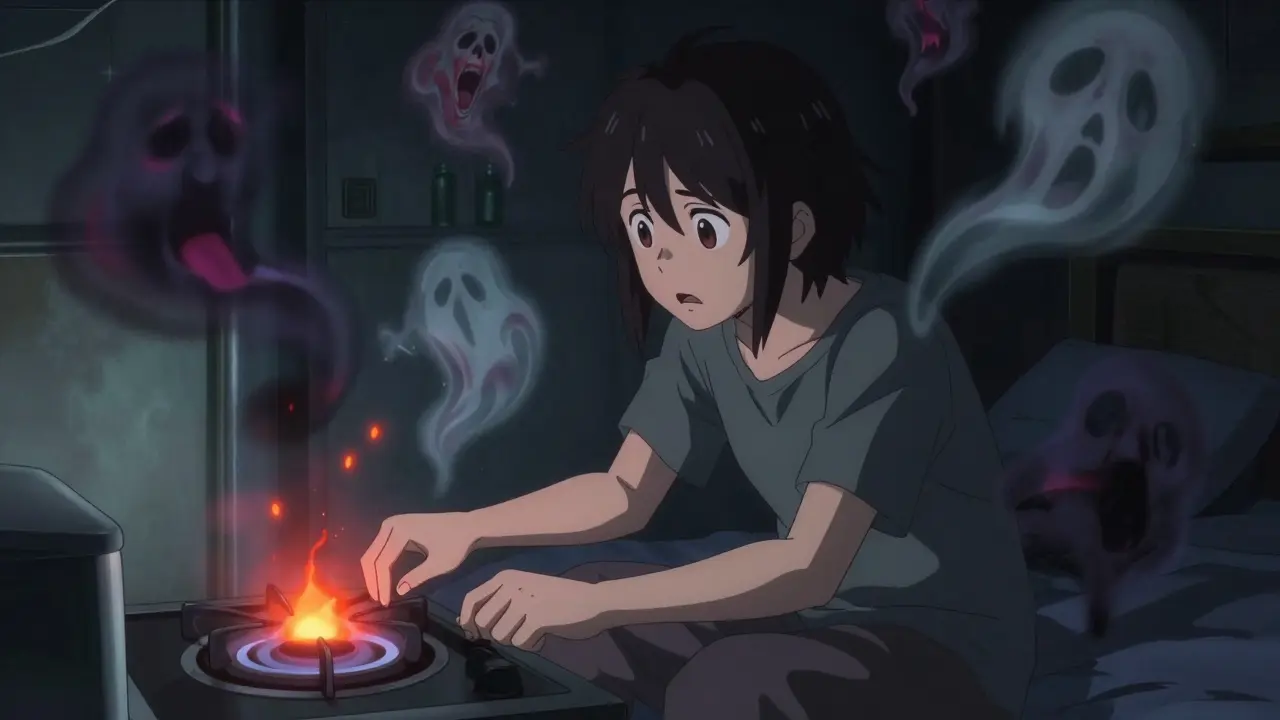
Imagine waking up and immediately fearing you might accidentally hurt someone-maybe your child, a stranger, or even yourself. You don’t want to. You’ve never been violent. But the thought keeps coming back. Loud. Clear. Unshakable. You check the stove ten times. You wash your hands until they crack. You repeat a prayer in your head until the anxiety fades-just for a moment. Then it comes again.
This isn’t just being careful. It’s OCD.
Obsessive-Compulsive Disorder isn’t about liking things neat or being a perfectionist. It’s a brain disorder that traps people in a cycle of terrifying thoughts and rituals they can’t control. And the worst part? Most people who suffer from it don’t even realize what’s happening. They think they’re broken, dangerous, or going crazy. They stay silent for years.
What Are Intrusive Thoughts in OCD?
Intrusive thoughts are sudden, unwanted ideas that pop into your mind. They’re not fantasies. They’re not desires. They’re like mental glitches-violent, sexual, blasphemous, or horrifying images that feel completely out of character.
Here’s what they actually look like in real life:
- Driving down the road and suddenly imagining swerving into a group of pedestrians.
- Holding a baby and thinking, ‘What if I drop them?’ even though you love them deeply.
- Seeing a religious symbol and having an image of desecrating it flash through your mind.
- Doubting your own sexuality or gender identity so intensely that you can’t trust your own feelings.
These aren’t rare. Almost everyone has them once in a while. But for someone without OCD, they’re like a passing cloud-noticeable, maybe annoying, then gone. For someone with OCD, they’re a siren. They trigger panic. They feel like proof. Like you’re a bad person. Like you’re dangerous. And that’s where the trap begins.
The brain doesn’t know the difference between a thought and a plan. So when you have a violent thought, your mind screams: ‘If I’m thinking this, I might do it.’ That’s the lie OCD tells. And to silence the scream, you perform a compulsion.
The OCD Cycle: Obsession → Anxiety → Compulsion
OCD runs on a loop that feels impossible to break:
- Obsession: A thought, image, or urge pops up-usually something you find repulsive or terrifying.
- Anxiety: Your body reacts like you’re in real danger. Heart races. Sweating. Dread sets in.
- Compulsion: You do something to make it stop. Wash your hands. Check the lock. Say a prayer. Mentally review your actions. Avoid certain places.
- Temporary relief: The anxiety drops-for a few seconds, minutes, hours.
- Back to obsession: The thought returns. Stronger. More frequent. More terrifying.
This isn’t willpower. It’s biology. Brain scans show people with OCD have overactive circuits in the orbitofrontal cortex and caudate nucleus-the areas that handle fear and decision-making. Their brains get stuck on ‘danger’ mode, even when there’s no real threat.
And here’s the cruel twist: the more you try to fight the thought, the stronger it gets. Trying to suppress it is like telling yourself, ‘Don’t think about a pink elephant.’ The more you try not to think it, the louder it becomes.
How Common Is OCD?
One in 83 adults in the U.S. has OCD-that’s about 1.2% of the population. But the real number is likely higher because most people hide it.
Symptoms usually start before age 25. Men often show signs earlier-sometimes in childhood. Women tend to develop symptoms in their late teens or early 20s. And the most common types of obsessions? Contamination (25%), harm (20-25%), symmetry (15-20%), and taboo thoughts like sex or religion (10-15%).
Compulsions follow the same pattern: checking (30%), handwashing (25%), mental rituals like counting or repeating phrases (20%), and hoarding (15%).
What’s worse? People wait over 10 years on average to get the right diagnosis. Why? Because they’re ashamed. They think they’re evil. They fear being labeled a criminal. One person on Reddit said they spent seven years terrified to tell anyone about their doubts over their gender identity. Another said their checking rituals cost them their job.
Why Traditional Therapy Often Fails
Most therapists aren’t trained in OCD. If you go to a counselor who doesn’t know the difference between OCD and general anxiety, they’ll likely do what feels natural: talk it out.
‘Tell me more about that thought.’ ‘Why do you think it keeps coming back?’ ‘What does it mean about you?’
That’s the opposite of what you need. Talking about intrusive thoughts reinforces them. It turns them into puzzles to solve. And OCD thrives on analysis. The more you analyze, the more real the threat feels.
Medication helps some people. SSRIs like fluoxetine or sertraline can reduce symptoms by 40-60%. But side effects-nausea, weight gain, low sex drive-cause 30% of people to quit. And even then, the thoughts don’t disappear. They just feel less urgent.
What works? There’s only one treatment proven to break the cycle: Exposure and Response Prevention, or ERP.
What Is ERP Therapy?
ERP isn’t talk therapy. It’s action therapy. It’s about facing your fears without doing the ritual that makes you feel safe.
Here’s how it works:
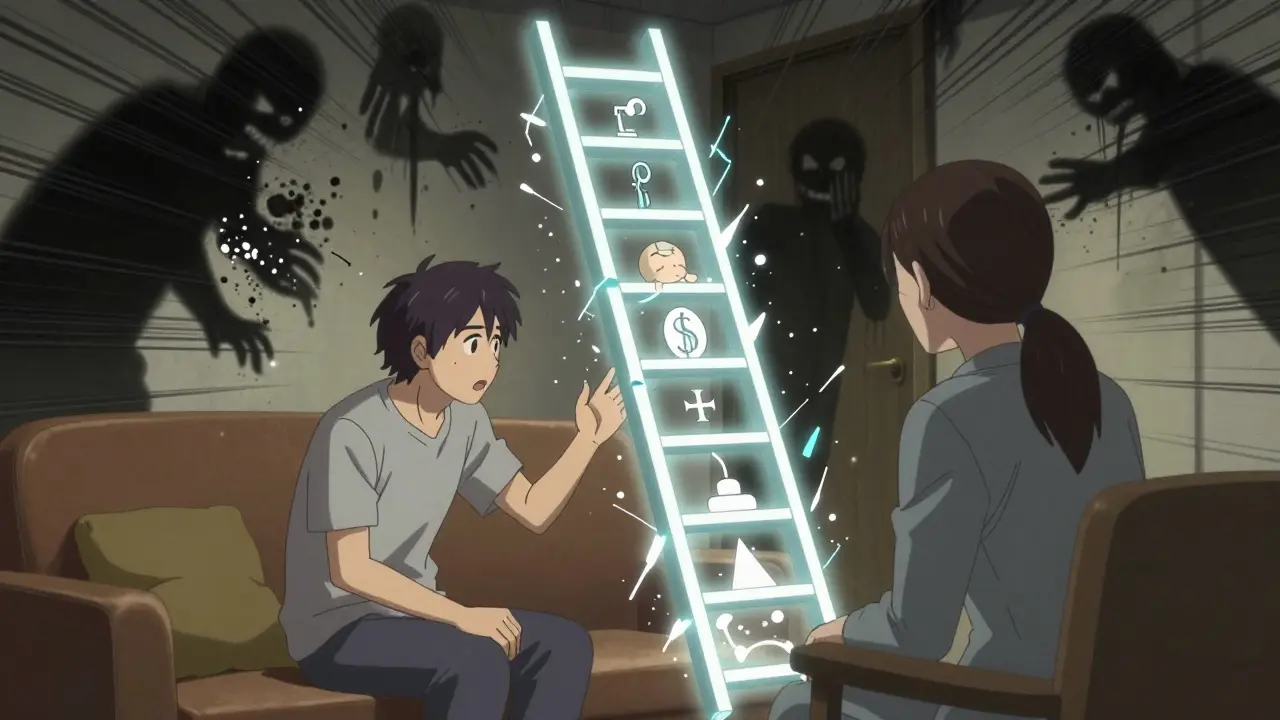
- You and your therapist make a ‘fear ladder.’ You list situations that trigger your obsessions, ranked from least to most anxiety-provoking.
- You start with the easiest. For someone with contamination fears, that might be touching a doorknob without washing your hands.
- You sit with the anxiety. Let it rise. Let it peak. Let it stay. No washing. No checking. No mental reviewing.
- You do this again. And again. Until your brain learns: ‘The anxiety goes away on its own. I didn’t die. I didn’t hurt anyone. Nothing bad happened.’
It’s not easy. In the first two to three weeks, 70% of people feel worse. The anxiety spikes. The thoughts scream louder. Many quit here. But if you stick with it, something changes.
After 12 to 20 weeks of weekly sessions and daily homework (1-2 hours a day), 60-80% of people see a major drop in symptoms. And those gains last. Five years later, 65% still feel better.
One 14-year-old girl went from spending 4-5 hours a day on rituals to less than 30 minutes after six months of ERP. She went back to school. Started hanging out with friends. Stopped hiding.

ERP for ‘Pure O’ - OCD Without Visible Compulsions
Not everyone washes hands or checks locks. Some people have what’s called ‘Pure O’-obsessive thoughts with only mental compulsions.
They don’t act out. But they do things like:
- Replaying conversations in their head to make sure they didn’t offend someone.
- Silently repeating prayers to neutralize a ‘bad’ thought.
- Trying to ‘prove’ they’re not gay, not a pedophile, not evil.
ERP still works. Instead of avoiding doorknobs, you might sit with the thought: ‘What if I’m a bad person?’ and not analyze it. Not reassure yourself. Not search for proof. Just let it sit. And let the anxiety fade without doing anything.
The DSM-5-TR now recognizes Pure O as a real and distinct form of OCD. And it affects about 20% of people with the disorder.
What’s New in OCD Treatment?
Technology is helping. In 2023, the FDA approved the first digital therapeutic app for OCD: nOCD. It guides users through ERP exercises. In a 2022 study, it helped 55% of people with mild OCD reduce symptoms.
Telehealth has made treatment more accessible. Before the pandemic, only 5% of OCD patients got therapy remotely. Now, it’s 45%. But insurance still doesn’t cover it equally. Only 60% of plans pay the same for virtual ERP as in-person.
And research is moving fast. Stanford researchers used AI to predict who will respond to ERP-with 78% accuracy-by looking at brain scans. Transcranial magnetic stimulation (TMS) is helping people who don’t respond to therapy or meds, with a 45% success rate in recent trials.
But the biggest barrier isn’t tech. It’s stigma. Only 35% of people with OCD seek help within the first year. Sixty percent fear telling their employer. One in three wait over a decade for the right diagnosis.
You’re Not Broken. You’re Not Dangerous.
If you’re reading this and you recognize yourself, here’s the truth: having intrusive thoughts doesn’t make you a bad person. It makes you human. And having OCD doesn’t mean you’re weak. It means your brain is stuck in a loop-and that loop can be broken.
ERP isn’t magic. It’s hard. It’s messy. It’s terrifying. But it works. And you don’t have to do it alone.
Find a therapist trained in ERP. Use the International OCD Foundation’s directory. Join a support group. Talk to someone who gets it. The silence is what keeps you trapped. The connection is what sets you free.
Your thoughts don’t define you. Your actions do. And if you’re seeking help? That’s already your most powerful action.






Comments (11)
Mike Rengifo
December 19, 2025 AT 17:38 PMBeen there. Thought I was gonna end up in prison because I kept imagining pushing someone in front of a train. Turns out? My brain just glitches. ERP saved me. Not easy. But worth it.
Vicki Belcher
December 20, 2025 AT 13:20 PMThis hit me right in the chest. 🥹 I spent 8 years thinking I was evil because I had thoughts about hurting my dog. Turns out I just have OCD. ERP is terrifying but it works. You’re not alone. 💪❤️
Dorine Anthony
December 21, 2025 AT 13:48 PMThank you for writing this. So many people think OCD is just being tidy. I wish I’d known this when I was 16. You’re not broken. You’re just wired differently. And that’s okay.
Emily P
December 22, 2025 AT 22:38 PMCan someone explain how ERP actually rewires the brain? I read the article but I’m still fuzzy on the neurobiology part. Like… what’s happening in the orbitofrontal cortex exactly?
anthony funes gomez
December 23, 2025 AT 03:03 AMThe neurocircuitry of OCD-specifically, the hyperactivity of the cortico-striato-thalamo-cortical loop-manifests as a failure of habituation in the fear-response system. ERP, by design, induces extinction learning through prolonged exposure without compulsive reinforcement. It’s not ‘curing’ anything. It’s recalibrating a maladaptive predictive coding model. The brain learns: threat signal ≠ action imperative.
Janelle Moore
December 23, 2025 AT 10:21 AMWait-so you’re telling me this isn’t just a sign you’re secretly a monster? I’ve been hiding this for 12 years because I thought if I told anyone, they’d call the cops. Now I’m supposed to just sit with the thought that I might be dangerous? That’s insane.
Ashley Bliss
December 24, 2025 AT 05:39 AMIt’s not just OCD-it’s the collapse of moral certainty in a post-truth world. We’re all haunted by the ghosts of our own potential. The intrusive thought? It’s the soul screaming, ‘What if you’re not who you think you are?’ ERP isn’t therapy-it’s a spiritual reckoning. And you? You’re brave for facing it.
Kelly Mulder
December 24, 2025 AT 11:00 AMActually, I find this entire narrative deeply problematic. You’re pathologizing normal human cognition. Everyone has dark thoughts. You’re creating a medical industry around existential anxiety. And calling it ‘therapy’? That’s capitalism at its finest. Also, ‘ERP’ is just exposure to fear dressed up in lab coats. And don’t get me started on the nOCD app. I’m not downloading an app to fix my soul.
Edington Renwick
December 26, 2025 AT 10:24 AMPeople like you don’t understand the gravity of what you’re saying. You think this is just ‘thoughts’? No. It’s the unraveling of identity. I used to sit in my car for an hour after driving past a school because I was terrified I’d hit a kid. I didn’t even drive near schools for five years. And you want me to ‘sit with it’? I’m not brave. I’m just tired.
Mark Able
December 27, 2025 AT 10:25 AMJust did my first ERP exercise today. Touched a public restroom door handle and didn’t wash. Felt like I was gonna die. But I didn’t. And now I’m sitting here crying because I realized… I’ve been lying to myself for 10 years. This is the first time I’ve felt even a little free.
Lynsey Tyson
December 27, 2025 AT 20:34 PMTo everyone here: I see you. I’ve been where you are. You’re not broken. You’re not dangerous. You’re just carrying a heavy weight no one else can see. And you’re still here. That’s strength. Keep going. One step. One breath. One moment at a time.